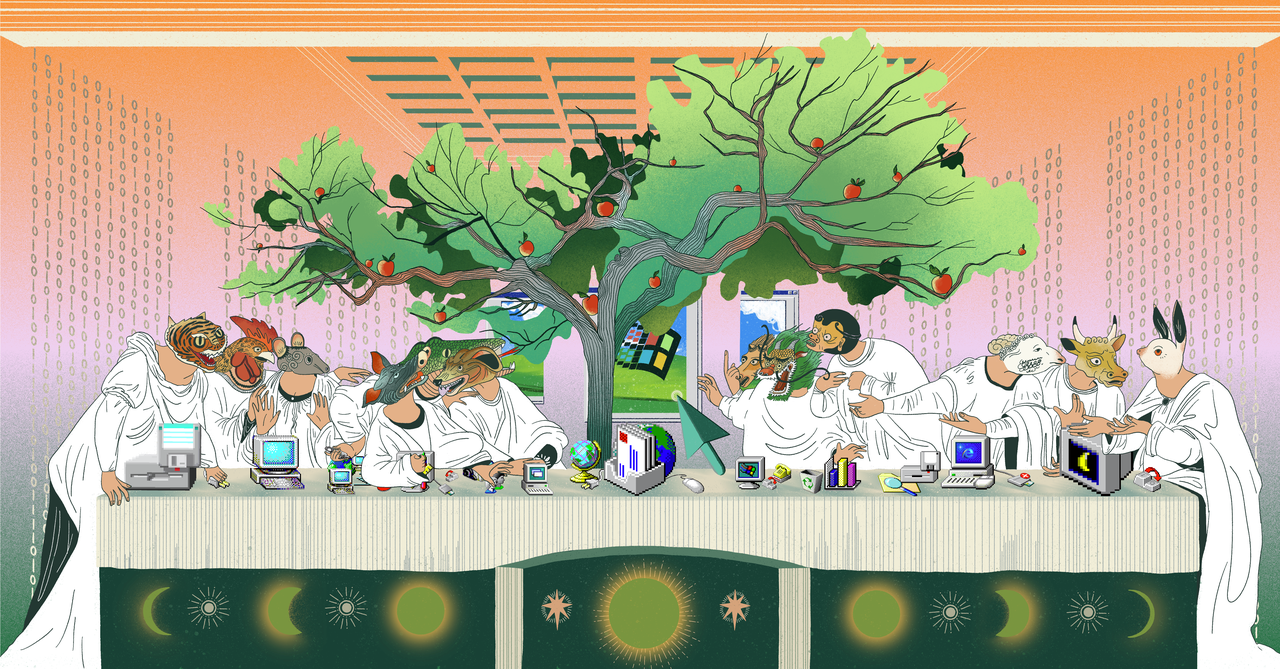
This participatory workshop format invites participants to imagine speculative landscapes shaped by rising sea levels. Through small-scale narratives and collective reflection, it exemplifies how creative methods can contribute to tackling complex societal issues and drive innovation policies.
When conversations about climate change rely too heavily on abstract data or apocalyptic imagery, it can become difficult to imagine how future change might actually be lived and experienced. This methodology opens space for more nuanced, grounded, and discussable futures through drawing and storytelling activities.
It Happened Tomorrow exemplifies how creative methods contribute to tackling complex societal issues and can drive innovation policies.
Purpose
This workshop is designed to help participants develop grounded and diverse climate imaginaries by working through visual and narrative practices. Instead of approaching climate change only through data or abstract scenarios, it creates a space to explore how future transformations might be lived, felt, and negotiated in specific places.
By combining archival images, drawing, and storytelling, the workshop supports participants in:
translating distant climate projections into situated, relatable futures
moving beyond purely dystopian or techno-optimistic narratives
exploring adaptation as a social, cultural, and more-than-human process
generating conversations around possible futures and shared values, including the specific roles where policy can intervene.
The format is particularly suited to opening up discussion, rather than converging on solutions, and can be used to surface perspectives, tensions, and alternative ways of imagining life with climate change.
This workshop is for you if…
You are working on climate-related topics and want to move beyond abstract discussions or data-driven approaches
You are looking for ways to engage people in imagining future change in a more situated and personal way
You want to introduce participatory and creative methods into policy and agenda-setting conversations about climate adaptation
You are working with cultural collections and want to activate them in addressing urgent societal priorities, such as climate change
You are facilitating groups with diverse backgrounds (e.g., students, researchers, policymakers) and need a format that does not rely on prior expertise
The workshop works particularly well when participants can connect the exercise to places they know or care about, allowing imagination to build from lived experience rather than from abstraction.
Why use this method?
The workshop combines archival images, drawing, and storytelling to create a low-threshold entry point into imagining climate futures.
Archival images provide a concrete starting point. They ground the exercise in existing landscapes and histories, making it easier for participants to move from what is known to what could change. Rather than imagining from scratch, participants work with traces of the past, creating a tension between past and future that helps trigger speculation. Images from the archive are also used as a proxy to connect with personal places and histories, bringing the topic of climate change closer to home.
Drawing keeps the process open and exploratory. It allows participants to externalise ideas quickly, without needing to fully articulate them in words. Because drawings remain unfinished and ambiguous, they leave space for interpretation and renegotiation.
Storytelling adds a narrative layer, which in this workshop is often done through small formats such as postcards, letters, or fictional scientific marginalia. These formats work at the scale of one voice, one moment, one relationship, making large and abstract climate issues more tangible. Writing from the future to someone (a friend, a family member, or the present self) invites participants to think relationally, not only about what will happen, but about responsibility, care, and coexistence. As fragmentary forms, postcards and diary-like texts do not aim to explain everything; they capture partial perspectives, closer to how climate change is actually experienced. Their combination of place and voice (an altered landscape paired with a short, situated account) offers a compact way to explore everyday life in a transformed environment without reducing it to a single, fixed narrative.
Together, these elements support a form of imagination that is both grounded and open-ended; encouraging participants to move beyond abstract or catastrophic visions, while still engaging with the complexity and uncertainty of climate change.
Before you run your own workshop
Prepare a curated image set Select or create a collection of images that participants can use as starting points. These should be open enough to invite interpretation, but grounded in recognisable landscapes or situations
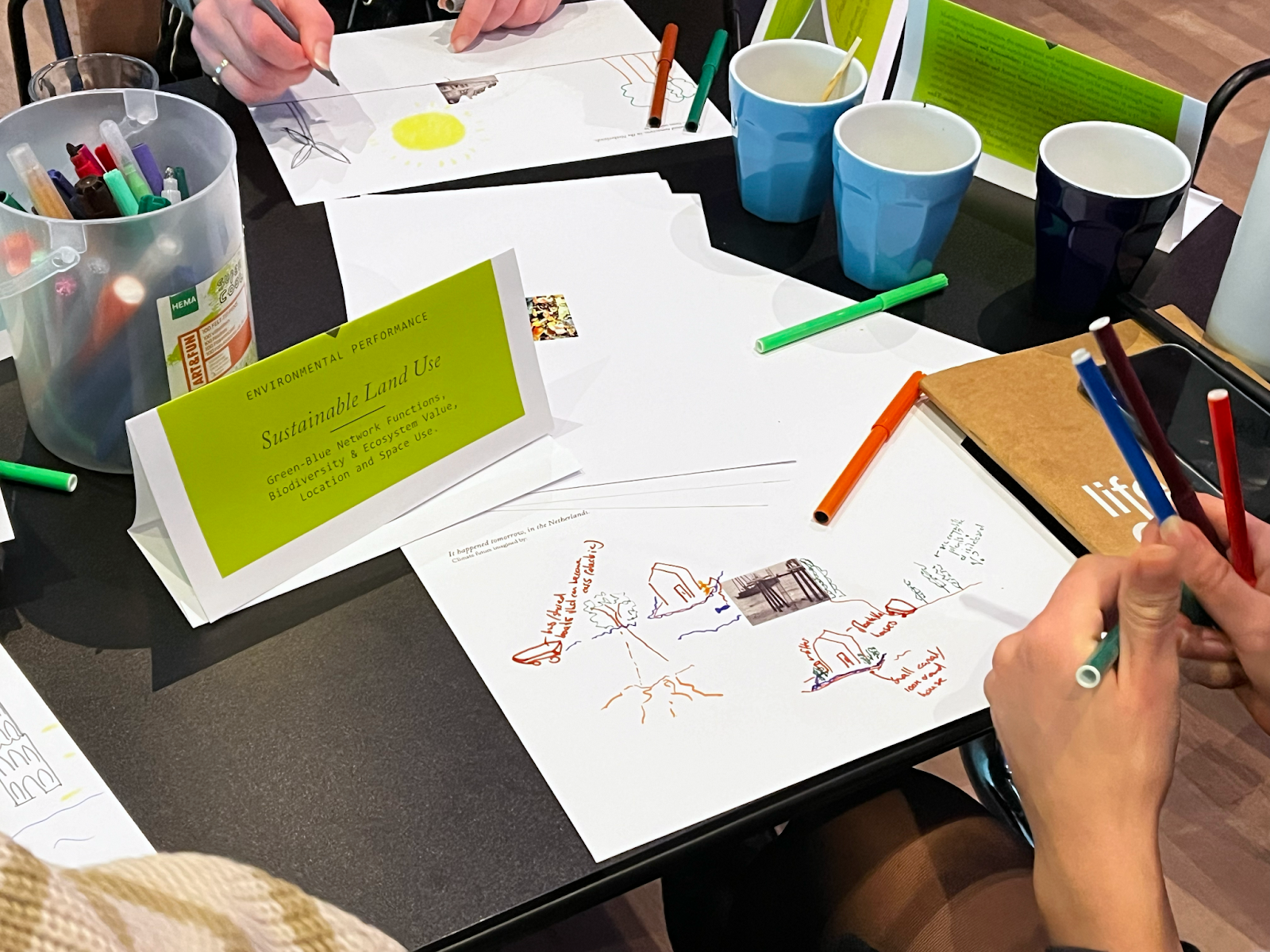
Print the images as working canvases Place each image at the center of an A4 sheet, leaving space around them for drawing and annotations. You can include short prompts or instructions on the back to support the exercise without overloading participants.
A curated selection of print-ready canvases can be downloaded below:
Gather simple materials Provide paper, pencils, and markers. The workshop works best with minimal, accessible tools that allow participants to start quickly without technical barriers.
Set up the space Use a room with large tables and good lighting, where participants can spread out images and work comfortably. Arrange the images so they are visible and easy to browse.
Prepare a short introduction Plan a brief framing of the workshop (5–10 minutes). This can include:
why imagining climate futures is difficult
a simple reference to a future scenario grounded in science (e.g. sea level rise projections in the Netherlands)
Keep this part concise to leave space for the hands-on work.
Decide on storytelling formats and other optional elements Depending on your time and audience, you can include:
thematic prompts (e.g. governance, biodiversity, daily life), see section below.
a storytelling format (postcards, letters, dialogues).
AI tools to expand drawings or generate narratives
These elements can support the exercise, but are not required. In several iterations, reducing complexity helped participants engage more deeply.
Using thematic prompts (New European Bauhaus model)
In some iterations of the workshop, thematic prompts were introduced to help participants situate their imaginaries within specific aspects of climate adaptation. These prompts were inspired by the New European Bauhaus (NEB) impact model, which connects environmental, social, cultural, and governance dimensions. This model has been developed by and for policymakers as a framework that brings together environmental sustainability, social inclusion, and aesthetic quality to guide and assess holistic approaches to climate adaptation and transformation.
Rather than presenting the full model, participants were invited to work with a small selection of themes, such as: biodiversity and nature restoration, water management and flood risk, governance and collective decision-making, cultural identity and sense of belonging, everyday life and wellbeing.
Each theme was accompanied by a short, open question (e.g. “How will public transport adapt to rising sea levels?”, or “How would working with nature look like as a climate adaptation strategy for cities?” or “What makes a neighborhood diverse?”), encouraging participants to anchor their drawings and stories in specific concerns.
Introducing thematic prompts helped some participants move beyond purely aesthetic or abstract imaginaries and connect their speculative landscapes to concrete adaptation challenges. At the same time, experience from the workshops showed that too many themes or overly detailed descriptions could quickly become overwhelming. A limited number of well-introduced prompts (one to three) tends to work best, allowing participants to engage more deeply while still leaving space for open exploration.
You can download a selection of NEB thematic prompt cards and browse related resources below:
Why choosing the right storytelling format matters
Epistolary narratives like diaries and postcards have long been used in fiction because they feel like private documents: we overhear someone’s thoughts rather than a distant narrator explaining the world. Short, intimate formats serve as an equivalent of found footage: the story feels like evidence rescued from a particular moment in time, which helps make imaginary futures feel real. For climate topics, this small scale is crucial: it shrinks a big problem into one (more-than) human, one landscape, one day, one message. A postcard is always written to someone (a friend, a lover, a future self, a grandchild, even a river or a city). That built-in correspondent invites to think relationally: not just “what will happen?” but “what do I owe you in that future?” Asking people to write from the future to their present-day selves, or from affected communities to distant readers, to surface response-ability and care. Moreover, letters, postcards, or even diary entries serve as fragments of a narrative we don’t fully know. That is also how we usually encounter climate change as an issue, where nobody has the complete picture, and people patch together meaning from memories, news, scientific evidence, and other media. Epistolary formats keep things open and ambiguous, which can help resist the totalising master narrative that big tech or techno-solutionism often offers.
For your workshop, think of the audience you are working with. A short storytelling format can take many shapes and invite different registers: if you ask participants to write a postcard to a relative, it might invite them to surface more intimate reflections or mundane observations. If you ask them to write a fragment of a field report from a future scientist, the tone of voice and content of the speculations will be different.
The Workshop Steps
01
Introduction (5–10 min)
Briefly introduce the workshop and its focus on imagining climate futures. Frame the exercise as a way to explore how change might be lived in specific places, rather than as an abstract or technical problem. If useful, refer to scientific studies on future climate projections to anchor the time horizon. For this series of workshops, I used scientific projections of sea-level-rise adaptation scenarios from the study “Uncertain Accelerated Sea-Level Rise, Potential Consequences, and Adaptive Strategies in The Netherlands” (van Alphen & Haasnoot, 2022).
Provide a specific timeframe for participants to imagine their future scenarios. This might be connected to the scientific projection you plan to use, and will have a profound impact on the type of imaginaries produced. Thinking about what might change in 10 years is a different thought process than imagining 150 years in the future. You don’t need to be super specific, but think in terms of time ranges (near future vs. distant future).
02
Image selection (5 min)
Invite participants to browse the image collection and choose one that resonates with them. Encourage them to pick an image that reminds them of a place they know, care about, or feel connected to. This helps ground the imagination process from the start.
In this series of workshops, still frames from public-domain videos in the Openbeelden and Europeana archives were used to illustrate various relationships among humans, water, and environments.
The following special collection includes footage of the great North Sea flood of 1953, newsreels showcasing traditional Dutch crafts and activities in and around the water, documentaries on water-management infrastructure and wildlife in aquatic ecosystems, and accounts of the mundane daily lives of people living with water in the Netherlands.
03
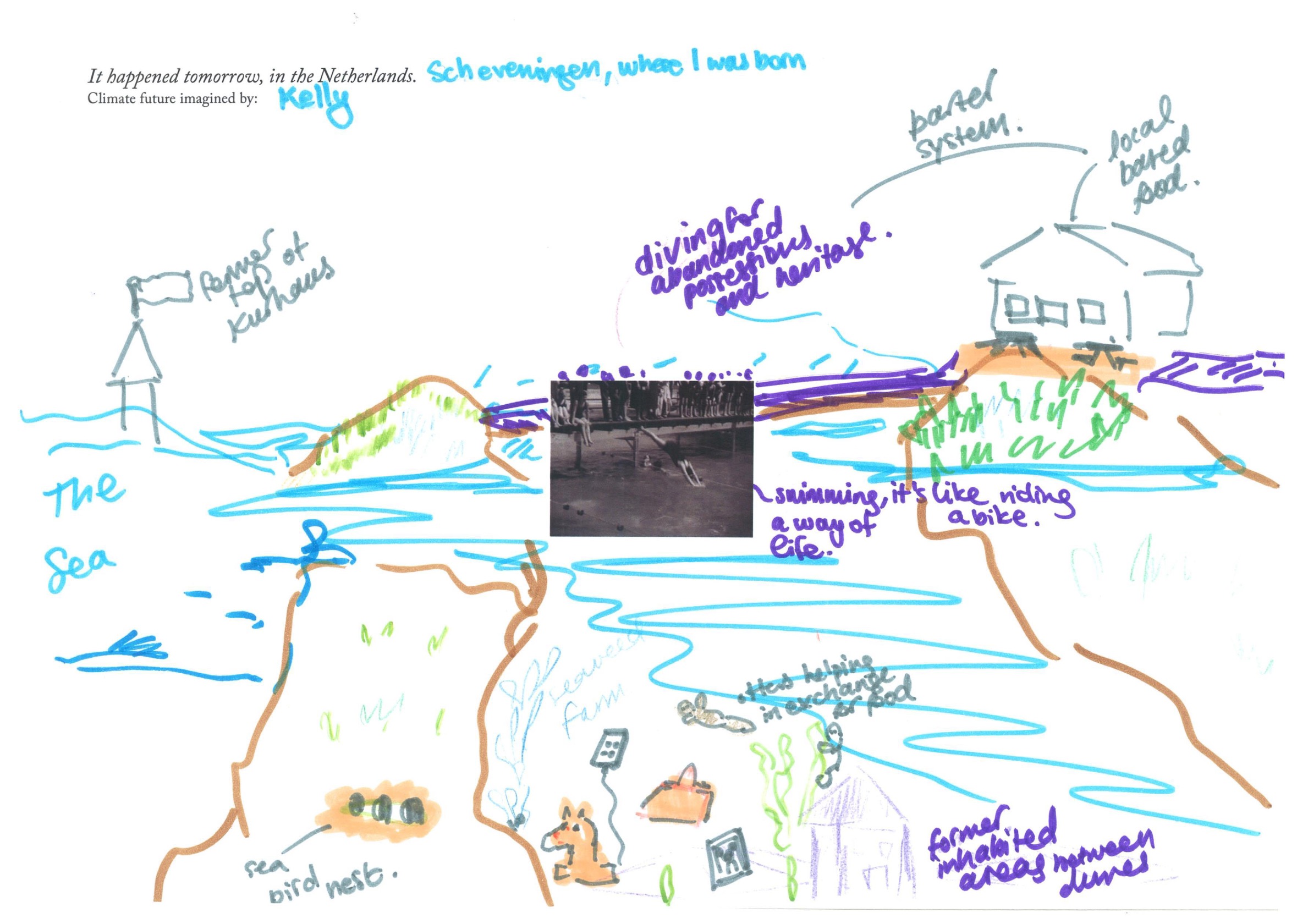
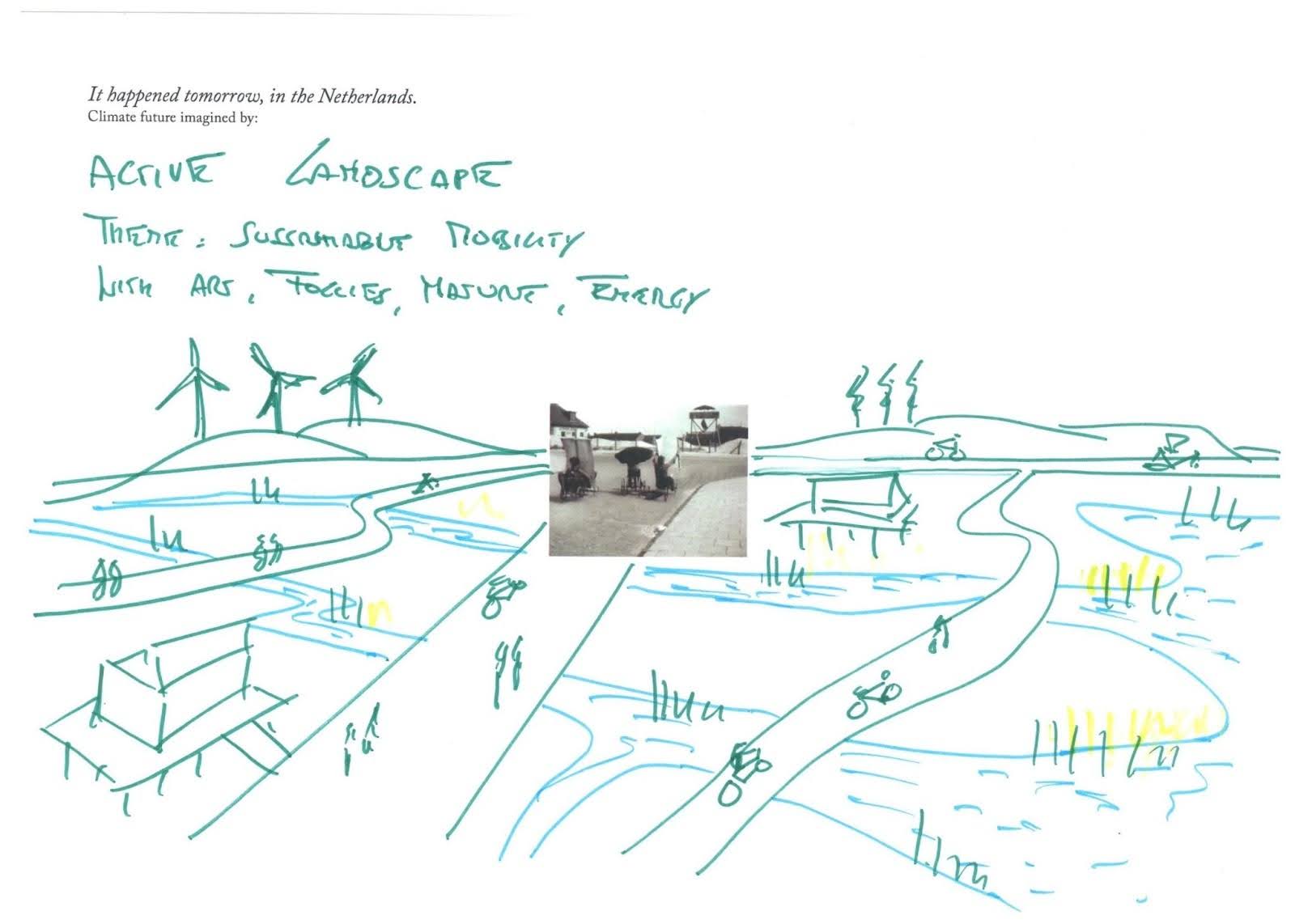
Speculative drawing (15–25 min)
Participants draw directly onto the printed image, imagining how that place might transform in a future shaped by climate change.
You can support this phase with a few guiding questions:
What does this place look like in the future?
What has changed, and what has remained?
How do people live with these changes?
Which other species are present, and how do they relate to humans?
If you decide to use specific prompts from the policy (see, for example, the New European Bauhaus framework in the previous section), make sure to dedicate enough time to properly introducing the prompts.
The focus of the exercise is not on drawing skills, but on exploring ideas. Encourage participants to annotate their drawings with short notes.
Example speculative drawing
04
Sharing in small groups (10–15 min)
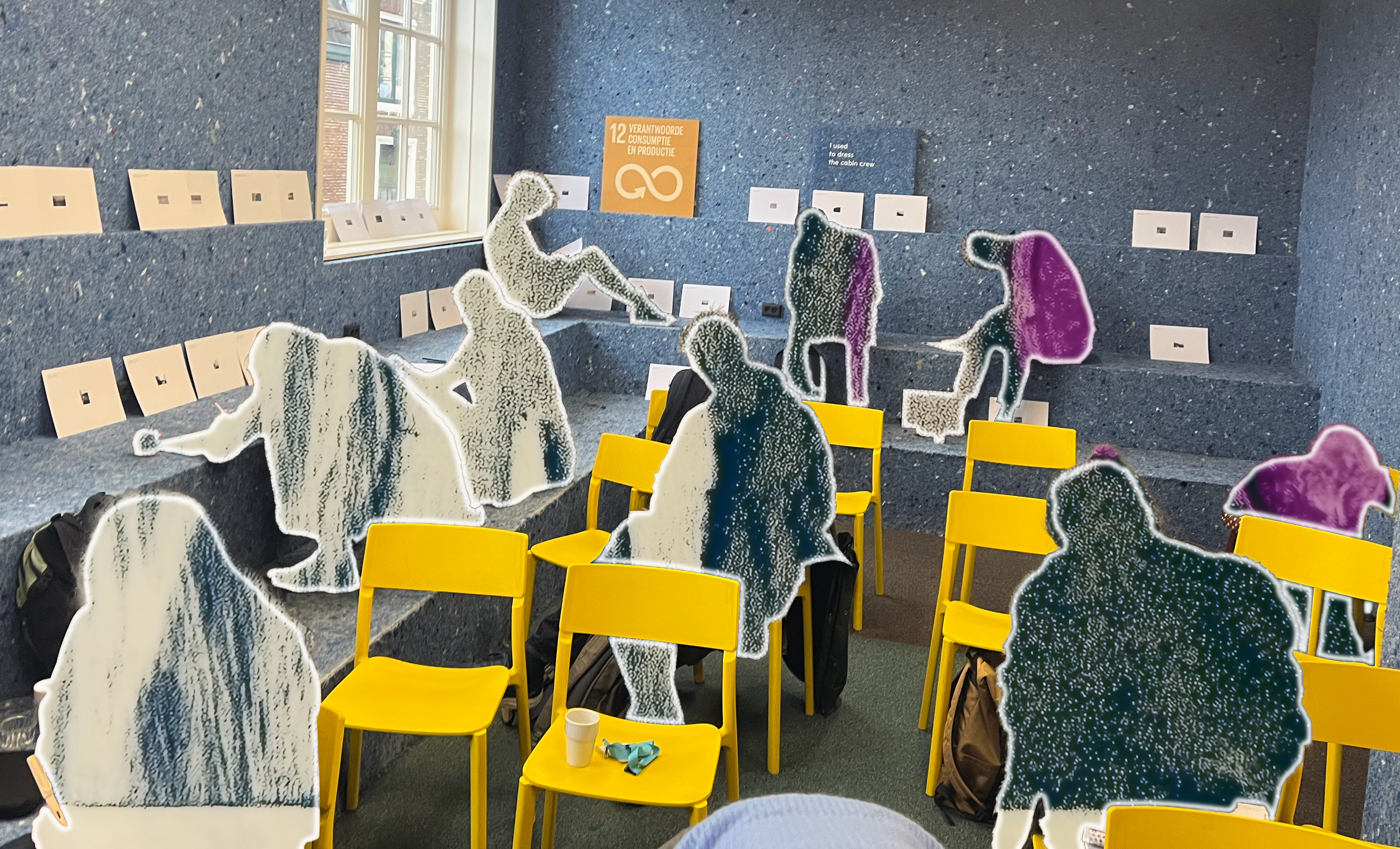
Participants form small groups (2–4 people) and present their landscapes to each other. This moment allows them to compare imaginaries, notice recurring themes, and reflect on differences in how futures are envisioned.
05
Collective storytelling (15–25 min)
Each group develops a short speculative narrative based on their drawings. This can take the form of a postcard, letter, or short text written from the perspective of someone living in that future.
Encourage participants to focus on everyday life, relationships, and small details, rather than large-scale explanations. The goal is to make the imagined future more tangible and situated.
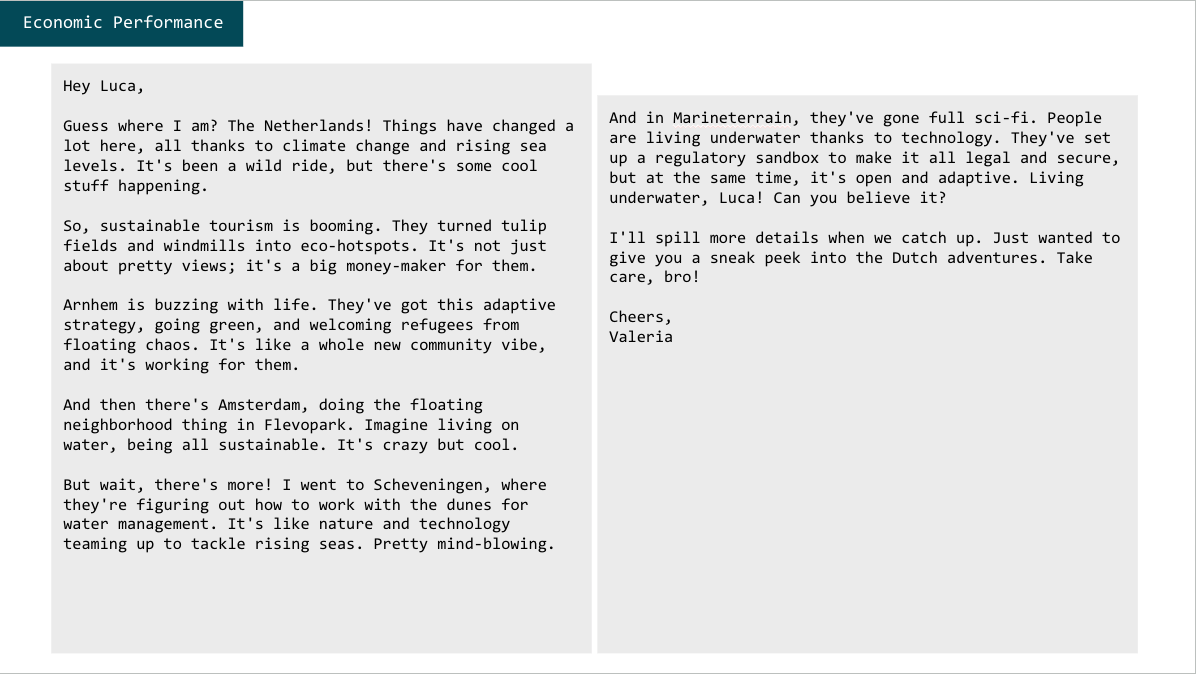
This part of the exercise can be developed in many ways: for example, in one iteration of the workshop, participants shared their drawings in pairs and then wrote each other postcards from their imagined landscapes. In another iteration, participants were grouped based on the theme they selected at the beginning of the session (i.e.: water management, public transport, etc). In groups of 4-5 people, they shared their imagined adaptation scenarios and then wrote a single text as a letter from a future researcher traveling through each of their landscapes, forming a sort of collective field notes document.
Example letter
06
Plenary reflection (15–20 min)
Bring the group back together and invite participants to share selected drawings and stories. Guide a collective reflection on the process, for example:
What made it easier or harder to imagine the future?
How did starting from an image influence the outcome?
What kinds of futures emerged?
What tensions became visible?
Use this moment to connect the exercise back to broader questions around climate adaptation, imagination, and lived experience.
Optional: Working with generative AI
In several iterations of the workshop, generative AI was introduced as a tool to expand participants’ drawings and narratives. The intention was to use AI as a sparring partner to reframe, misread, or exaggerate participants’ ideas.
On the one hand, AI can support the imagination process. It allows participants to quickly extend a sketch into a larger landscape, explore alternative versions of the same place, or generate narrative perspectives that might not emerge immediately.
At the same time, its use introduces several challenges. The visual and textual outputs can create a strong “wow-effect,” which risks shifting attention away from participants’ own imaginaries, focusing the discussion on the technology itself. AI systems also tend to simplify, generalise, or aestheticise complex situations, sometimes flattening the specificity of place-based narratives. This can also be used productively to surface assumptions, biases, and gaps in both human and machine imaginaries.
There is also a broader tension in using generative AI within a climate-focused workshop. These systems rely on energy-intensive infrastructures and large-scale data extraction, raising questions about the environmental and ethical implications of their use.
Additional things to consider
Start from a familiar place Inviting participants to connect the exercise to a place they know or care about makes the imagination process more concrete and detailed. When the starting point is too abstract or generic, the outcomes tend to remain vague or overly speculative.
Balance guidance and openness The workshop benefits from some structure (e.g. guiding questions, thematic prompts), but too much information can overwhelm participants and limit their imagination. When using themes (such as policy areas or impact models), it is more effective to:
focus on one to three themes
introduce them properly, but keeping descriptions short and accessible
Keep the method lightweight Simple materials and clear steps help participants engage quickly. Adding too many layers (tools, instructions, formats) can fragment attention and reduce the depth of the experience.
Prioritise reflection over production It is tempting to focus on outputs (drawings, AI images, stories), but the most valuable part of the workshop often emerges during discussion and exchange. Make sure to leave enough time for collective reflection.
Use AI carefully Generative AI can stimulate imagination, but it can also distract from the core exercise. In several iterations, the “wow-effect” of AI shifted attention away from participants’ own ideas. To use it effectively:
treat it as optional
keep prompts simple and grounded in participants’ work
use unexpected or imperfect outputs as material for discussion
Give participants agency to use, review, critique, and modify AI outputs
Work with small narrative formats Formats such as postcards or letters help keep the focus on lived experience rather than abstract explanation. Their scale encourages participants to explore one moment, one voice, or one relationship, making climate futures more tangible and relatable.
Allow for different modes of participation Not all participants engage in the same way. Some may prefer drawing, others writing, others discussion. Allow flexibility in how people contribute, and avoid forcing all participants into the same format.
Clarify the time horizon Participants can struggle if the temporal frame is unclear. Briefly indicating a timeframe (e.g. near future vs distant future) helps anchor the exercise without over-constraining it.
Accept partial and fragmented outcomes The workshop does not aim to produce complete or coherent visions of the future. Fragments, contradictions, and unresolved ideas are part of the process, and can open up more meaningful discussions than fully resolved scenarios.
Document conversations, not only outputs The value of the workshop often lies as much in the discussions as in the drawings or stories produced. Consider lightweight ways of documenting these exchanges, such as:
capturing key quotes, tensions, or recurring themes on a shared board
Rather than aiming for full transcripts, focus on collecting fragments that reflect how participants negotiate, question, and reinterpret each other’s imaginaries.
Consider ethics and participant involvement If the outputs or discussions are used for research, exhibitions, or publications, it is important to move beyond treating participants as contributors of raw material. This can include:
being transparent about how materials will be used
asking for consent for documentation and reuse
crediting participants where appropriate
sharing results back with them (e.g. reports, visualisations, exhibitions)
Keeping participants in the loop helps position them as co-creators rather than as subjects of extraction, and can strengthen the continuity of the work beyond the workshop itself.