AI and Cultural and Creative Industries
 New European Bauhaus – CCIs enabling green transition
 Immersive Media
 Crafts-led Innovation
 Platformisation of the Music Industry
 Inclusivity in Video Game Industry
 Cross-Innovation with Performing Arts
 Fashion Transition: Eco-Design for Circularity
 Cultural Heritage Institutions within Open Innovation Ecosystems
 New funding models for creativity and innovation
 Spaces, infrastructures, and ecosystems for CCIs
 Reimagining Deep-Tech
 Digital Commons
Held Together by People, Not Systems
What happens when a career moves between disciplines, sectors, and systems? Part of a series of portraits on Europe’s creatives, this story explores Chloe Spiby Loh’s path from architecture to cultural production, revealing how creative ecosystems are built through connection, care, and the people who bring fragmented communities together.
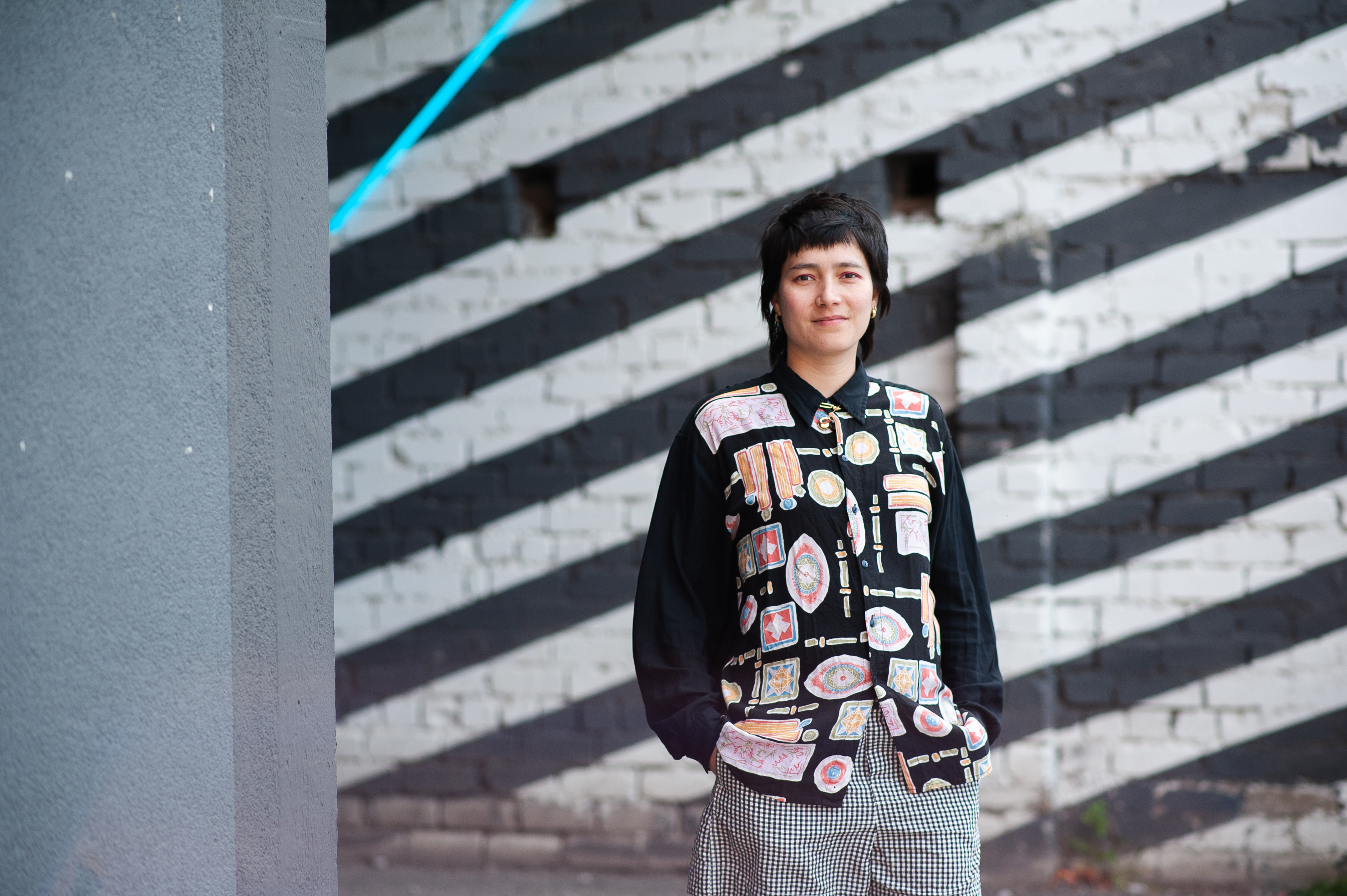 Photo by Jana Laigo
-
Author
- Bodil Malmström, ekip (2026)
-
Audience
-
Geographical scope
-
Region
-
Resource type
From architecture studios to UK-wide arts programmes, Chloe Spiby Loh’s journey traces a path through disciplines, sectors and systems. Being part of ekip Academy she learned how to translate her experience into policy language — and questioning how ecosystems survive without the people who hold them together.
Chloe Spiby Loh’s professional story does not begin with policy papers or funding frameworks, but with architecture and an upbringing saturated in creativity. With a mother working as a graphic and textile designer, a father who is an architect, and grandparents who were art teachers, she grew up inside a constellation of disciplines rather than a single career path.
“I was good at everything at school,” she recalls. “Architecture let me do writing, history, drawing and maths. It felt like a synthesis of everything.”
But even as she trained in architecture, Chloe was never primarily interested in buildings. What drew her in was the structure of thinking itself, the way disciplines intersect, overlap and inform one another. That instinct would eventually pull her away from traditional practice and into cultural programming, curation and what she now describes as ecosystem building.
Curating across boundaries: art, science, and now technology
After leaving architecture practice, Chloe moved into cultural organisations that explored architecture through exhibitions, events and public programming. Over time, her work expanded beyond architecture entirely into interdisciplinary cultural production — bringing together art, science, health and technology.
Today, she works as a producer on a UK-wide programme funding artists to use technology. The initiative, supported by arts councils across the UK alongside research funders, supports artists who are often entering the field of immersive and digital practice for the first time.
“It’s operational, but also connective,” she says. “I support artists to meet technologists, labs, other artists. It’s about building the conditions for work to happen.”
The programme, running from 2024 to 2027, has already supported multiple cohorts of artists across the UK. While formally time-limited, it has attracted strong interest with oversubscription rates leaving only a small percentage of applicants successful.
“This shows there’s appetite,” Chloe explains. “Artists want to engage with technology, but it’s expensive and they don’t always have the skills or infrastructure.”
Building ecosystems from scratch
In Scotland, where she is based, she describes her role as creating connections that did not previously exist: linking artists to venues, equipment, training and collaborators across fragmented sectors.
“I didn’t have a venue or kit to give them,” she says. “So I had to build relationships with people who did.”
But this connective role comes with a paradox. The ecosystem, she argues, often appears to function because of individuals who hold it together rather than because of formal structures that sustain it.
“It worries me that if I disappear, parts of the ecosystem might collapse,” she says. “Because it exists in relation to the people who connect it.”
This dependency, she adds, is rarely recognised in job descriptions or funding structures, despite being central to how cultural infrastructure actually operates.
There is also a human cost. Roles that depend on relational labour and informal coordination often lead to burnout, particularly when they are not formally valued within organisational systems.
Measuring what matters
One of Chloe’s strongest reflections concerns evaluation and what gets counted.
While her current work collects both quantitative and qualitative data, she admits she is uncertain how to translate qualitative insight into meaningful reporting or storytelling.
“I don’t know how to turn it into something communicable,” she says. “Or whose job that even is — communications, research, policy?”
She is now exploring more structured approaches to capturing impact, including simple but systematic tracking methods such as logging inquiries, connections and referrals between organisations.
This shift is particularly important as she prepares to start a new role at a privately funded arts foundation, where she will help design programmes and build systems from scratch.
Unlike publicly funded structures, she hopes this environment may offer more flexibility to design evaluation methods from the beginning rather than retrofitting them later.
Tools, translation and a policy vocabulary
Chloe joined the ekip Academy in Tallinn June 2026 to better understand how innovation policy is shaped and how practitioners like herself can influence it.
Her interest stems from working within systems shaped by earlier policy decisions that leave little room for adaptation. She implements established frameworks and receives feedback from artists, but has limited ability to change the underlying structure.
Through ekip Academy, she has found value in practical frameworks particularly tools for mapping futures, backcasting, and visualising systems. One method in particular, focused on building blocks between current reality and desired outcomes, has resonated strongly.
“It’s simple, visual and transferable,” she says. “I can already see how I’ll use it in my next job.”
A future beyond silos
Looking ahead, Chloe is clear about the structural change she would like to see: a less fragmented understanding of culture, design, innovation and creative industries.
In the UK, she argues, these fields are often separated into distinct policy domains, a division she finds artificial given how practitioners actually work.
“I move between art, culture and design all the time,” she says. “But the system doesn’t always know how to recognise that.”
She also sees potential in more bottom-up policy co-creation where practitioners, artists and funders shape frameworks together rather than sequentially.
For Chloe, the future is not about choosing between disciplines, but recognising the value of those who operate between them.
“It’s about making ecosystems sustainable,” she says. “Not just creating them, but maintaining them and making sure they don’t depend on one person holding everything together.”