This tool shares co-created practices and language for collaboration that prototype how to build bridges between the different actors and sectors participating in open innovation ecosystems, specifically aimed at the cultural sector. Geared at minimising and removing barriers to collaboration, these examples of shared languaging can help to navigate the innovation landscape.
If you’re experiencing frustrations in collaborating across sectors, explore these collaborative practices and compasses for innovation that prototype a shared language.
Introduction
Language can be both a barrier and a bridge to collaborating across contexts and sectors. Jargon-heavy or vague terms make it more difficult to understand each other’s problems, build trust, and sustain collaboration. Rather than forcing alignment, how can we frame and practice innovation in a way that opens dialogue?
Future Forward Hackathons are ekip’s method for translating emerging societal, technological, and environmental priorities into forward-looking opportunities for the CCIs. Developed as part of thisongoing programme, the collaborative practices and compasses for innovation as outlined below invite innovation actors to reflect on how they talk about and practice open innovation.
Using creative methods to mix imagination and policy, we explored how shared ‘languaging’ can help us bypass tropes and traps. Bringing together the public innovation infrastructures imagined in our vert first Hackathon, and the provocative vision statements developed and published in zine-form in our second Hackathon, participants in the online hacking role-playing game (RPG) – Innovation Takes a Village engaged in the challenge of co-creating a model and language of innovation.
They developed collaborative practices and compasses for innovation that tackle recurring frustrations in collaboration, such as rigid hierarchies, gaps between ideas and needs, barriers to creatives, fear of change, slow pace or inertia, and chaos. Shared values such as courage, playfulness, sharing, and democratic processes emerged from the many ideas of how to better practice and ritualise collaboration.
What is a collaborative practice?
A collaborative practice is a prototype for developing shared approaches to innovation. Developed as part of the Innovation Takes a Villagehackathon, they can serve as a starting point for developing your own practices, as well as highlighting the ways in which we talk about and visualise collaboration.
These practices take the form of rituals, formats, and mechanisms.
Rituals are simple, repeated practices that build trust over time.
Formats are not one-off projects, but a repeating way of working that allows people to imagine futures together and share responsibility.
Mechanisms are a structure, agreement, or practice that continues after an event and keeps collaboration alive.
What is a compass for innovation?
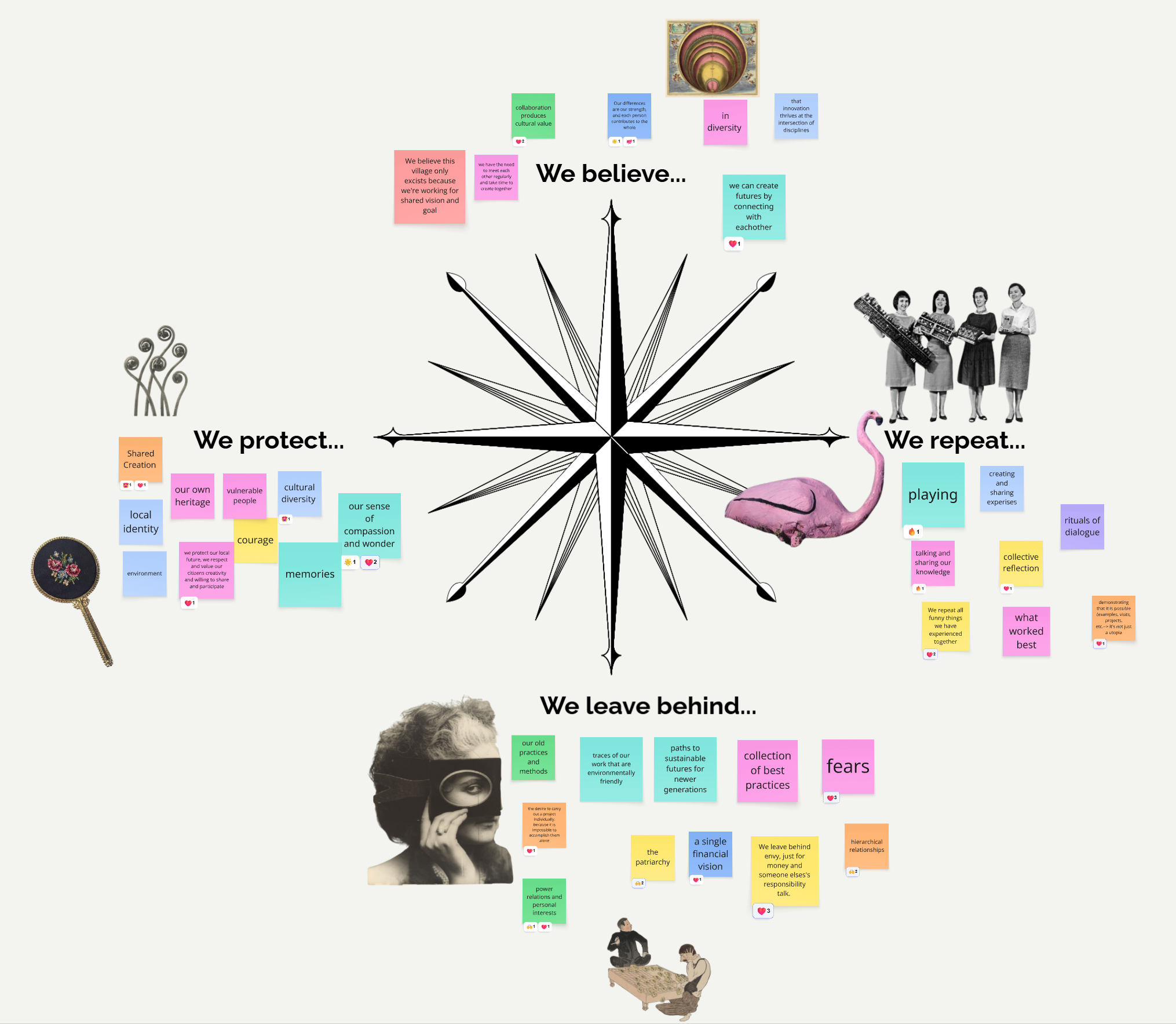
A compass for innovation proposes a shared language for orienting multiple stakeholders in the landscape of open innovation. They can be developed as a vision- and trust-building exercise/tool, as well as used to open dialogue around how innovation is framed.
The cardinal directions describe:
What is the shared belief or mission driving collaboration and innovation, ‘We believe…’
What practices and approaches are working and should be maintained, ‘We repeat…’
What is foundational and a prerequisite for collaboration and innovation, ‘We protect…’
What should be left to the past, either as a legacy or because exclusionary practices must change, ‘We leave behind…’
Collaborative Practices for Innovation
RITUALS
Spaces & Places: To facilitate connecting with each other, resources will be provided for anyone to organise regular gatherings in free public spaces. The ritual of meeting, sharing problems, and looking for solutions can be hosted in many spaces. Modular pop-up kiosks can be used for free as a platform. Insights, inspiration, and thank-you notes can be added to a publicly accessible pinboard. A community-written blog will share achievements and challenges. Across all these spaces, mutual peer review will help to reflect on what challenges the community chooses to influence or accept.
Sunday Sessions: A regular physical meeting where information is exchanged during an activity, such as a baking session, creative skill sharing, or a garage sale. The main aim of the ritual is to find and exchange hidden knowledge. It is inspired by rituals of women in community kitchens: singing and cooking together whilst also creating something together for each other. Before it starts, people decide on a location and a form of creation. It does not need to be cooking; it can be any activity, such as a garage sale or a film screening. They then define what will be created together, coordinate the logistics, and make sure they check in on each other if someone doesn’t show up – out of care, not control.
Tea & Tinkering: Shifting away from the formalities of meetings, “Tea & Tinkering” is a weekly get-together where villagers come together to share food and drink. The ritual starts before anyone even arrives, with people deciding together who’s bringing what. When everyone gathers, the focus is on making and mending: tinkering with ideas, fixing small problems, and experimenting with possibilities. Together they create a relaxed space to prototype solutions to everyday challenges in the village, testing ideas quickly and informally: sketching, building small mock-ups, trying things out on the spot. Conversations flow naturally between social time and problem-solving, so solutions grow out of shared experience rather than formal agendas. Over time, the ritual builds trust, shared ownership, and momentum. With the hope of turning neighbours into collaborators.
Shared Languaging
Rituals for collaboration were often envisioned as a gathering, where freely accessible and public spaces become shared meeting places. All rituals explored how to foster interaction and dialogue, as a basis for building trust and collaboration. The different mountain peaks and the various animals at the pond must first gather and learn about each other to build shared solutions. Across providing food and drink, free pop-up kiosks, reading clubs, film evenings, and live music, the red thread is finding ways to meet and connect with others physically.
FORMATs
Formats are not one-off projects, but a repeating way of working that allows people to imagine futures together and share responsibility. The following formats respond to the prototyped public innovation infrastructure of the Museum. While the future can be explored in many ways and places, this stop communicates the core challenge of how to share responsibility when stewarding innovation.
Personal and Shared Vision Statements: A repeated vision statement practice, where stakeholders, community members and museum staff come together to envision the future and understand each other’s needs and wants. As a jumping off point to crafting both personal and shared vision statements, people choose three objects from the museum’s collection to represent their vision for the future. Through object-led communication, this process can foster institutional community building and contribute to the slow process of changing mindsets.
Heritage of the House Collections: The museum holds a space for local people’s personal collections, and people from different generations and backgrounds come together to share the stories behind their collection. To ensure that museums are not static or only for observation it’s important to include and prioritise the stories of the people whose heritage they represent and showcase.
The Mobile Museum of the Obsolete: a two-fold format starting with simple and varied trust building and cross-generational activities, which are further built on with deeper programming. It will consist of monthly workshops where a group identifies objects or practices that will become obsolete in the future, such as bus cards in a sustainable future with free access to public transportation.
Shared Languaging
Formats for collaboration radically reimagined the role of a museum and its collections. If we want to think about a future together, we need to understand where we came from and where or who we are today. Museums and their collections can use object-based storytelling, participatory curation, gamification, and learning through playing to bring people together in a free public space to play a part in collaboratively envisioning the future.
MECHANISMS
Mechanisms are a structure, agreement, or practice that continues after the festival and keeps collaboration alive. The following mechanisms respond to the prototyped public innovation infrastructure of the Ongoing Festival. At this stop, we focus on the core challenge of how to create sustainable continuity and make meaningful things last.
Continue the conversation: the goal is to complement the festival programming by creating mechanisms to continue the conversation and strengthen the community. Starting simply, each festival will share ideas, comments, or thoughts that will be passed on to a new person to develop further during the next festival. A recurring micro-publication such as a zine, blog, or mail-out will further support continuing the conversation. At a structural level further materials, spaces and events will be provided to meet each other, such as co-living experiments and residencies, and a community-driven garden to return something to the land, creating a circular and continuous foundation for the festival.
Meeting at the Crossroads: this mechanism will continue festival activities in a shorter form, taking place in different village locations that are uncommon for a festival (a schoolyard, a crossroad, a parking lot). These activities will help to celebrate the local environment with festival attitude. The focus here is to bring something from the festival, whether it is artists or work from the artists, the organising staff of the festival, or even the litter for crafting workshops. In the uncommon location, people will gather and celebrate their surroundings and getting-together as something meaningful.
Changing Lives through Culture: Modeled, and aspiringly named, after Cheltenham Festival’s “Changing Lives through Culture” ethos, this festival mechanism emphasises skill-sharing and experimentation. Every invited contributor leaves behind a transferable skill, method, or toolkit. A portion of festival resources supports documentation and open access sharing (guides, recordings, templates), allowing others to adapt and replicate what was created.
SHARED LANGUAGING
Mechanisms for collaboration were often visualised as people from different walks of life coming together and celebrating. There was an emphasis on sharing knowledge and skills with other people and the land, to ensure that the impact of the festival ripples beyond a single event. Recycling festival materials to make postcards and gifs, setting up a notice board to continue discussions, and providing free materials all aim to provide support for sustaining collaboration.
Compasses for Innovation
A compass for innovation proposes a shared language for orienting multiple stakeholders in the landscape of open innovation. They can be developed as a vision- and trust-building exercise/tool, as well as used to open dialogue around how innovation is framed.
Shared languaging
The compasses for innovation were one of the last steps in using (visual) language to build consensus on collaboration. Through this process of shared languaging common themes were both chosen and emerged:
Protecting and supporting democratic and participatory processes: protecting community, art and nature; upholding diversity and representation; intergenerational practice; and removing barriers and leaving behind hierarchies.
Maintaining and growing our spaces to collaborate: free and open public spaces; celebrating art; becoming changemakers; and encouraging the intersection of disciplines.
Ritualising collaboration: take time to meet and create; take shared responsibility; circularity, repetition and consistency; and share knowledge and foster trust.
Building collaborative mindsets: courage, curiosity and the willingness to change; co-design and co-build; experimentation means welcoming failure; be playful; and compassion and wonder.
Dismantling collaborative paradigms: link individual experiences to shared experiences; prioritise circularity over linearity; and foster intergenerational collaboration by recognising wisdom comes from all ages.
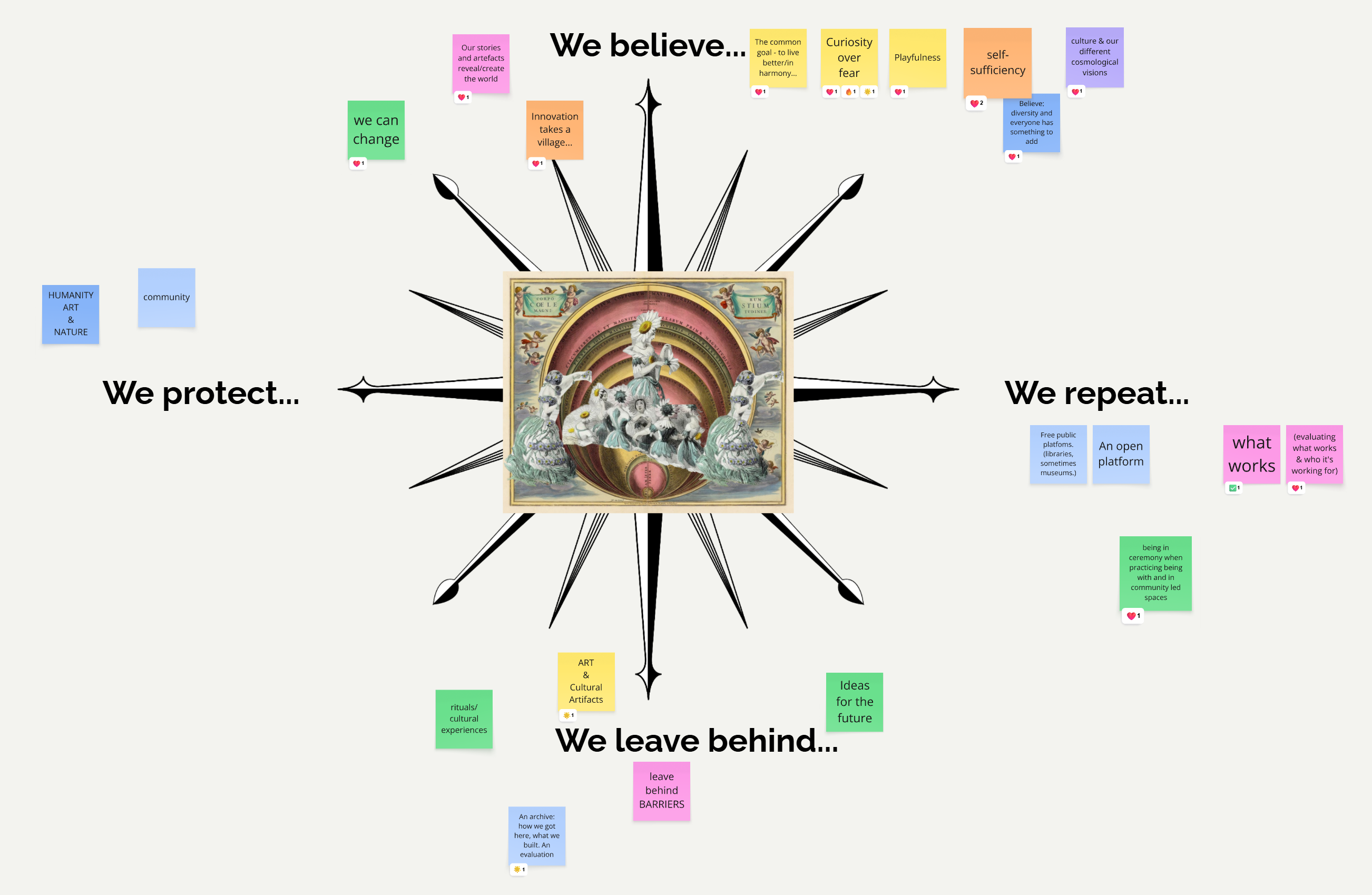
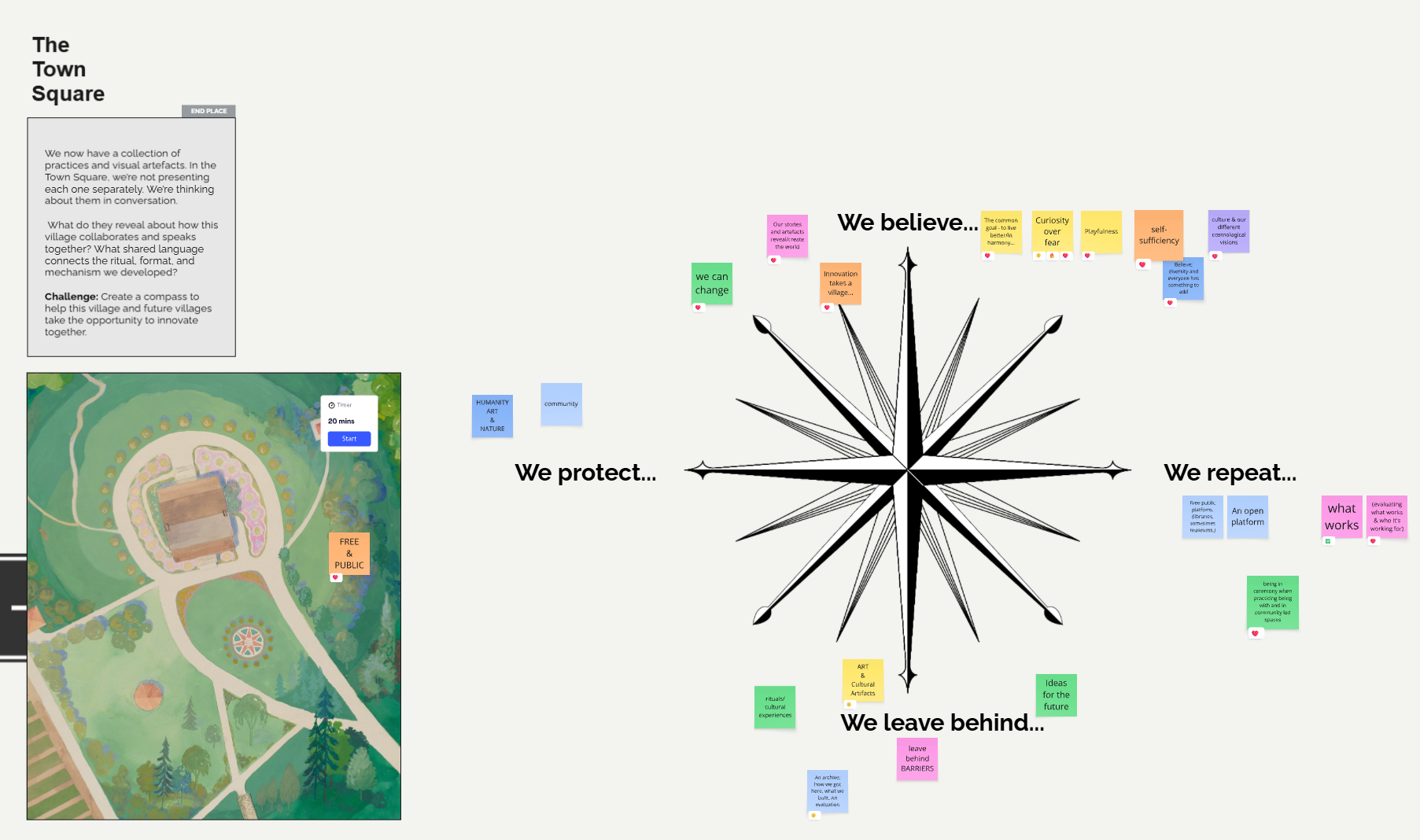
COMPASS 1
We believe…
In these mindsets and attitudes – we can change, listen to curiosity over fear, encourage playfulness, and that we are self-sufficient, but we also should learn from others
What drives us – to live better/in harmony, diversity & what everyone can add, innovation takes a village
Our resources – our stories & artefacts reveal/create the world; culture & different cosmological visions
We repeat…
Free and open public platforms
What works, therefore we must evaluate what works and who it’s working for
‘Being in ceremony when practicing being with and in community-led spaces’ – give the proper time and respect to relationship building and collaboration
We protect…
Humanity, art, nature, and community
We leave behind…
Legacy – ideas for the future, art & cultural artifacts, rituals & cultural experiences, archive, evaluation
Never again – ‘leave behind barriers’
COMPASS 2
We believe…
That collaboration produces cultural value.
Our differences are our strengths and each individual contributes to the whole.
We can create futures by connecting with each other.
We repeat…
Playing! This is a recurring element in our village.
Sharing (such as sharing knowledge and experiences, in the form of collective reflection & dialogue rituals)
We protect…
Our local future – a shared creation, our own heritage, through a common sense of curiosity and wonder.
We leave behind…
In the sense of legacy: we leave behind paths to sustainable futures with our collection of best practices
In the sense of avoiding: we leave behind envy, hierarchical relationships and personal interests.
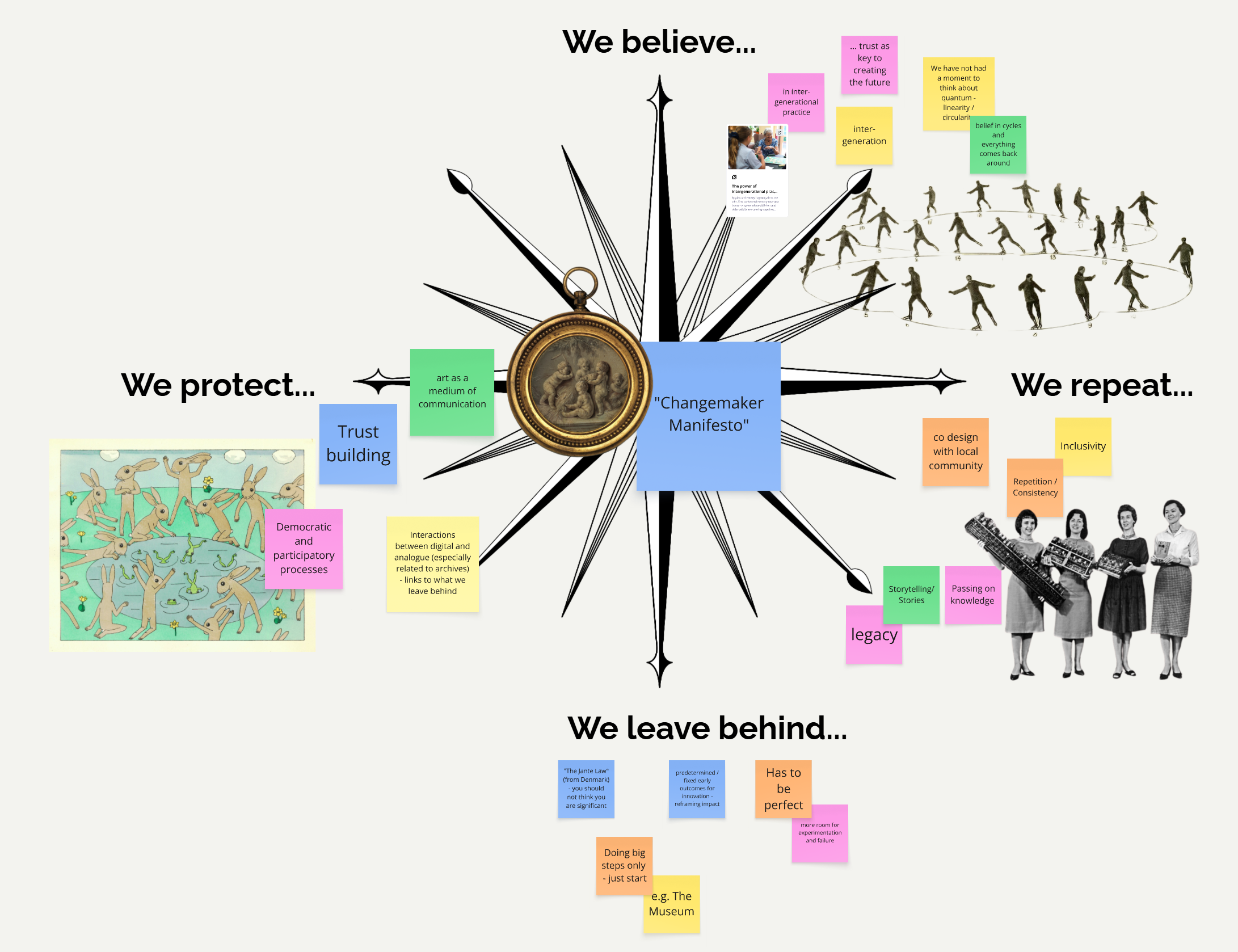
COMPASS 3
We believe…
In inter-generational practices.
That trust is key to creating inspiring and sustainable futures.
In non-linearity; we celebrate the cycles of learning and adapting as things emerge, re-emerge, and come back around.
We repeat…
Activities co-designed with local communities.
Inclusivity in practices.
Passing on knowledge and stories.
Repetition itself: if it works, we stay consistent with it.
We protect…
Democratic and participatory processes.
Interactions between the digital and analogue worlds, especially related to archives and what we leave behind.
Art as a medium of communication.
We leave behind…
Striving for perfection; we celebrate experimentation and failure.
Only taking giant steps; meaningful change can also happen little by little.
Predetermined or fixed early outcomes for innovation; we aim to reframe what “impact” means.
Conformity to societal norms (e.g., “The Jante Law” in Denmark and “Doe Normaal” in the Netherlands); we recognise that we can be significant without always adhering to norms.
Developing your own collaborative practices and compass for innovation
If you would like to run a Innovation Takes a Village session to co-create your own collaborative practices and compass for innovation, you can refer to our how-to guide for detailed instructions and templates.


 AI and Cultural and Creative Industries
 New European Bauhaus – CCIs enabling green transition
 Immersive Media
 Crafts-led Innovation
 Platformisation of the Music Industry
 Inclusivity in Video Game Industry
 Cross-Innovation with Performing Arts
 Fashion Transition: Eco-Design for Circularity
 Cultural Heritage Institutions within Open Innovation Ecosystems
 New funding models for creativity and innovation
 Spaces, infrastructures, and ecosystems for CCIs