This guide introduces Innovation Takes a Village, an interactive role-playing workshop designed to help cross-sector groups explore collaboration and innovation through playful experimentation. Step-by-step, you will see examples from an online session hosted in February 2026, for which this workshop was developed.
Screenshot from the Innovation Takes a Village workshop hosted February 2026
If you’re stuck in familiar ways of working and want to spark fresh ideas, use this interactive workshop to play, experiment, and discover a shared language for collaboration and innovation.
Purpose
How can innovation and cultural actors find a shared language that helps them understand (and work with) one another? Jargon, vague terms, and rigid KPIs can make working across contexts and sectors more difficult.
Hosted as part of ekip’s ongoing Future Forward Hackathons programme, Innovation Takes a Village is an interactive role-playing workshop that offers an open space for cross-sector imagination and exchange.
Rather than advocating for any one model or language of innovation, this online workshop creates one. Through collaboration and playful experimentation in a role-playing game (RPG) style setting, participants engage in a co-creation challenge aimed at bringing together shared perspectives on what makes collaboration and innovation flourish. They will meet, mix, and brainstorm in order to tackle societal problems together, tap into each other’s expertise and create meaningful exchange that can be applied in their own collaborative practices.
This facilitator guide will show you how to use the assets we created to run your very own Innovation Takes a Village workshop. As you follow the guide step-by-step, you will see examples from the third ekip Future Forward Hackathon, hosted online by the Netherlands Institute for Sound & Vision in February 2026, for which this workshop was developed.
This workshop is for you if:
You are working with cross-sector groups (e.g. policymakers, funders, practitioners, technologists).
You want to surface shared values and working principles.
You are looking for a structured but playful format to address coordination challenges.
You want participants to move from abstract future thinking to concrete collaboration practices.
You want tangible outputs that can inform strategy, policy, or network development.
Why a role-playing game (RPG)?
In this workshop, participants create a character based on themselves or a role they know well. This approach allows them to explore collaboration and decision-making from a familiar perspective while experimenting in a shared scenario. By stepping into these semi-real roles, participants can surface assumptions, test ideas, and uncover tensions in cross-sector interactions. The RPG format provides a structured yet playful space to move beyond abstract discussion and generate practical insights about working together within creative and cultural innovation ecosystems.
What Do We Mean by “Hacking”?
In this context, hacking futures does not refer to technical hacking. Instead, it describes a creative, critical, and playful intervention into existing assumptions about how innovation and policy are shaped.
Through role-play and collaborative prototyping, participants “hack” collaboration itself by:
Reframing how innovation ecosystems function.
Surfacing overlooked values and tensions.
Identifying structural gaps.
Imagining alternative infrastructures for working together.
Hacking is a way of breaking open repetitive conversations to make space for new narratives, metaphors, and possibilities. See materials from previous Hackathon sessions:
Define the scope – Clarify the theme you want participants to “hack” (e.g. funding models, support systems, future opportunities) and what’s in or out of scope.
Decide who should participate – Identify the voices you need (e.g. practitioners, funders, policymakers) and whether you want a mixed or focused group.
Plan the setup – Determine the workshop duration (typically 2–3 hours), group size, and facilitation roles.
Prepare materials – Gather any visuals or examples you’ll use during the session.
Configure your Miro board* – Make a copy of the template, adjust prompts to fit your theme, set up breakout areas, and ensure instructions are visible and easy to follow.
Brief participants – Send a short message with the purpose, schedule, and required tools (e.g. Miro access).
Plan how you’ll capture outputs – Decide how screenshots and notes will be collected and how results will be shared afterwards.
*All activities were designed using the digital whiteboard tool Miro. Activities from Innovation Take a Village can be referenced via the following Miro template.
STEP 1. WELCOME & INTRODUCTION – 20 minutes Introduce the goals, topic, and approach of the workshop while setting the scene for the RPG.
STEP 2. CHARACTER CREATION– 5 minutes Participants create a simple character to represent their perspective during the village journey.
STEP 3. THE VILLAGE JOURNEY– 65 minutes Participants travel to three public infrastructures before arriving at the village’s Town Square. Along the way, they will prototype collaborative practices and reflect on shared approaches to innovation.
STEP 4. SHARING & REFLECTIONS – 30 minutes Participants reflect on the practices they created, identify shared patterns and language, and consider how these insights can inform their own work
Note: For offline workshops, the framework and steps will remain the same, but facilitation set ups will differ.
01
WELCOME & INTRODUCTION
Purpose: Allow participants ~5 minutes to join the online session, the remaining time can be used to introduce the goals, topic, and approach of the workshop while setting the scene for the RPG.
Innovation Take a Village starts from one fundamental observation: policy language can be a barrier. Jargon, buzzwords, and rigid KPIs alienate practitioners and obscure the societal change their work can generate.
The workshop invites participants to reconsider language as a bridge, addressing the question: How can innovation and cultural actors find a shared language that helps them understand (and work with) one another?
Setting the Scene (script)
The village is active, creative, and full of ideas.
Innovation, culture, policy, and technology are all alive, but they don’t yet share a common way of working together— a shared language.
People care. Experiments happen.
Still, coordination is fragile. Meaning slips. Promising ideas struggle to travel across contexts.
You are temporary stewards of this village.
Your mission: to help your village develop a shared capacity to collaborate. To do this, you will be prototyping innovation practices that can be understood, adapted, and reused across different settings.
You’ll do this by visiting three public infrastructures in the village: a neighborhood house, a museum, and a festival.
For each practice you design (a ritual, format, and mechanism), you will choose a visual artefact to make it tangible and shareable.
At the very end, you will take your practices and artefacts to the Town Square where you will devise a compass to help your village, and future villages, better navigate innovating together.
Do not worry, you will have a village guide along the way!
Setting EXPECTATIONS
In your own words, invite participants to:
Get creative and critical
Raise new questions, provocations, and ideas
Plant seeds for future discussions and actions
Have fun
02
Character Creation
Purpose: Help participants embody a perspective in the village by creating a simple character.
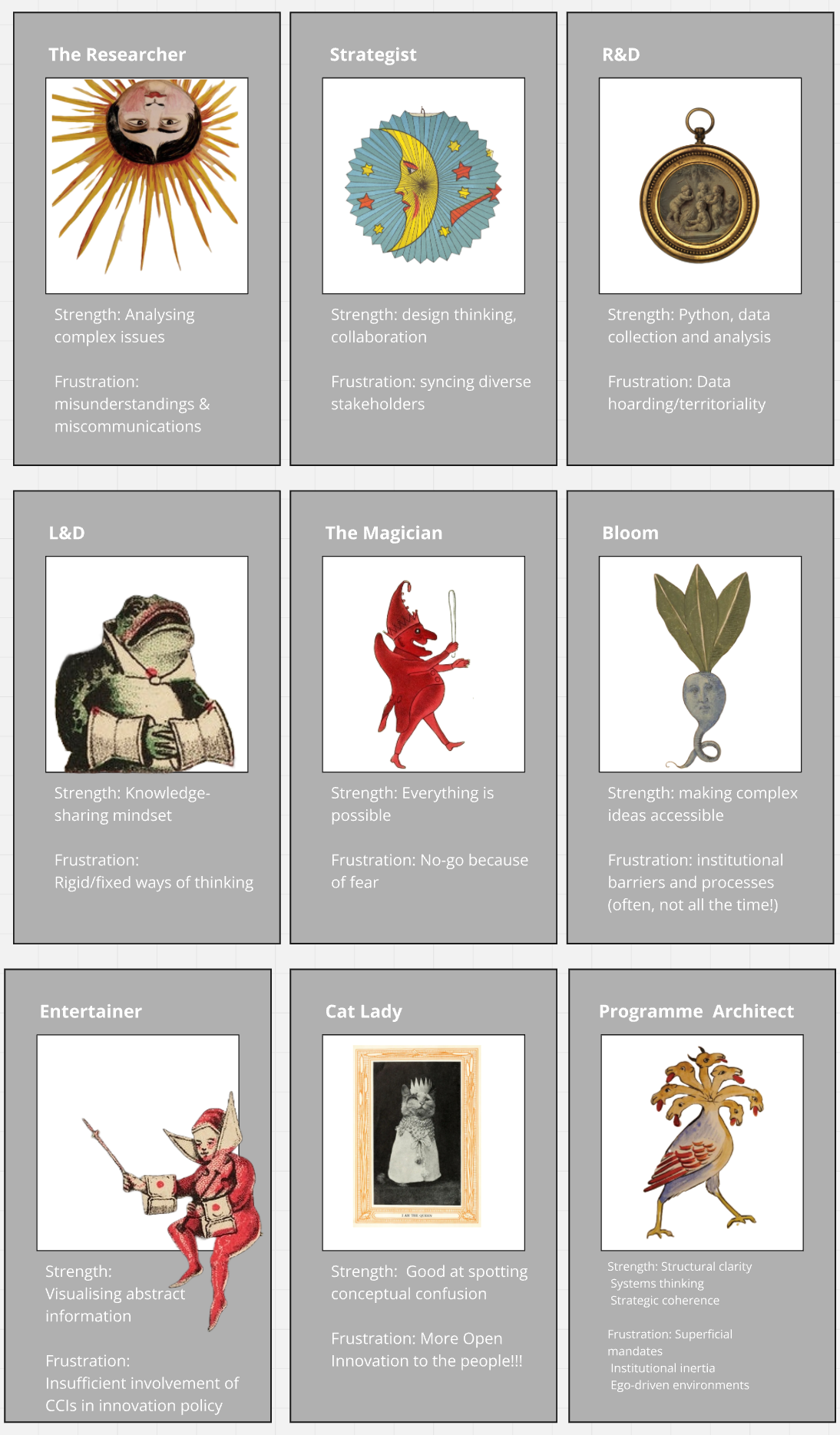
Participants are invited to create a simple character who has just arrived in the village. They should base their character on themself or a role that they know well (e.g. curator, policy maker, technologist, community organiser, student, funder).
In Miro, participants can select a character from a pre-made character library. They will then respond to the following prompts in one of the template character sheets:
Who are you?
What is one strength you bring to the village?
What is one frustration you often face when collaborating?
Participants will play this character throughout the journey.
Note: participants who join the session on time or early can complete this step as the facilitator waits for remaining participants to join the online session.
03
The Village Journey
Purpose: Guide participants through the village journey (3 stops before reaching a Town Square), helping them explore, prototype, and share collaborative practices at each public infrastructure.
Breakout rooms (if necessary)
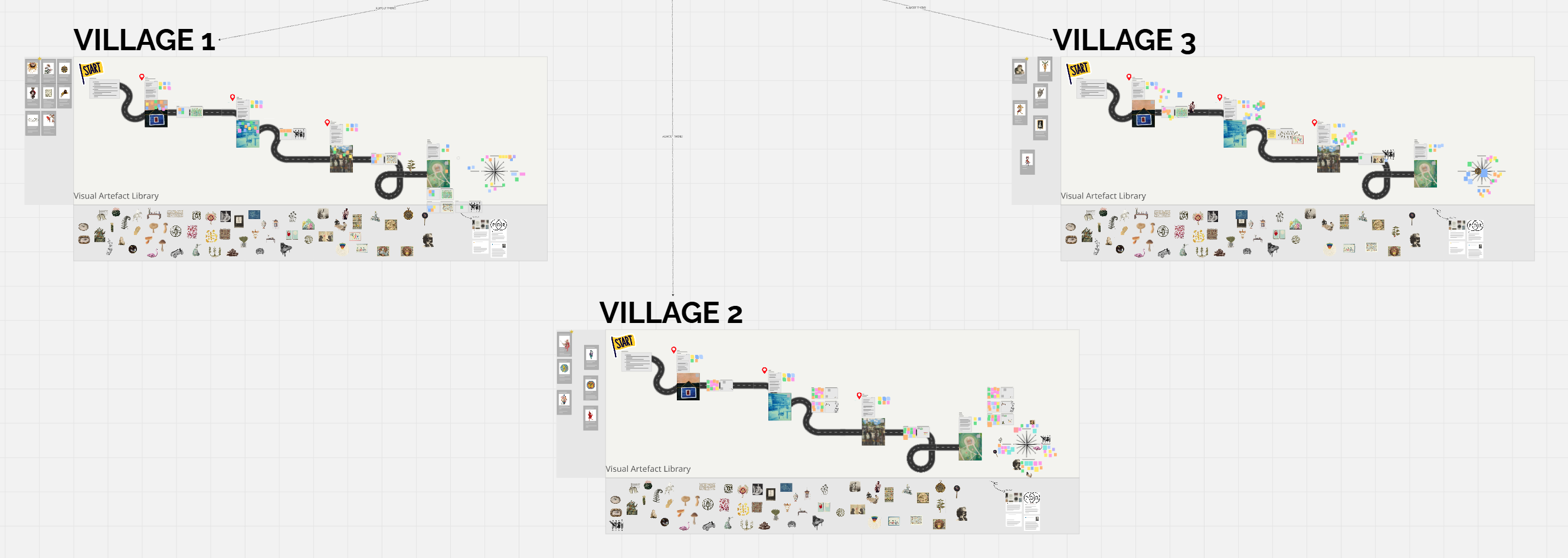
Depending on the number of participants, you may need to use breakout rooms. Each breakout room will require a village facilitator (e.g. if you have 3 breakout rooms, you will need 3 facilitators to guide each village journey). Similarly, each breakout room will need its own work space in the Miro, even though all rooms will follow the same village journey.
As a village facilitator, ensure that all participants in your breakout room have joined their shared work space (e.g. participants in breakout room 1 are in the village 1 workspace, etc).
Short introductions
Participants begin their journey by meeting their fellow village stewards. Using the character sheet they created in Step 2, they will introduce themselves to each other. Facilitators can use these character sheets as a reference point for later discussion.
RPG Instructions
Participants will travel through three public infrastructures in the village: a neighborhood house, a museum, and an “ongoing” festival. At each stop, facilitators should guide participants through the following scripted process:
Context: Share the background and challenge for the stop.
Brainstorm: Participants generate ideas individually or together based on the context.
Select: Participants agree on at least one practice to refine and a visual artefact to represent it.
Add to Board: Participants place their selection(s) in the grey boxes on Miro to indicate completion.
Participants will spend approximately 15 minutes at each stop, ensuring enough time to explore, prototype, and add their selections to the board.
Note: All three public infrastructures were imagined and prototyped in a previous ekip Future Forward Hackathon session, providing a foundation for the village journey participants will explore. Facilitators might adapt stops according to their own contexts and needs.
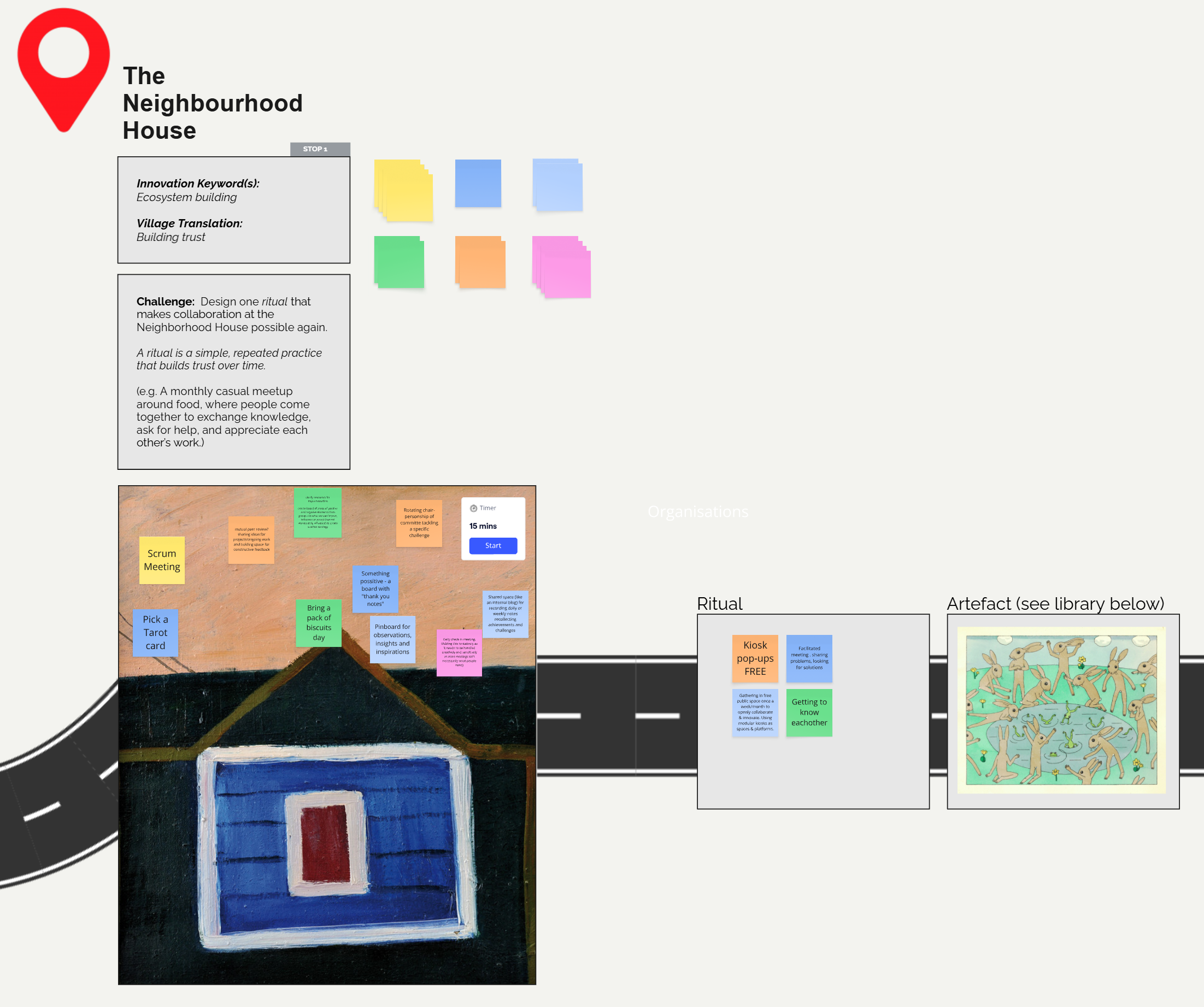
The Neighbourhood House is the oldest place in the village. People still gather here, but they arrive with very different expectations. Some bring funding news. Some bring deadlines. Others bring lived experience or urgent local problems. A past innovation project tried to “include everyone,” but people felt heard without much changing.. leading to feelings of doubt/mistrust. Before the village can innovate, it has to relearn how to meet.
Challenge (script)
Design one ritual that makes collaboration at the Neighborhood House possible again.
(A ritual is a simple, repeated practice that builds trust over time.)
Example (script, optional)
A monthly casual meetup around food, where people come together to exchange knowledge, ask for help, and appreciate each other’s work.
Stop 2 – The Museum
Innovation Keyword(s): Innovation Stewardship
Village Translation: Sharing Responsibility
Background (script)
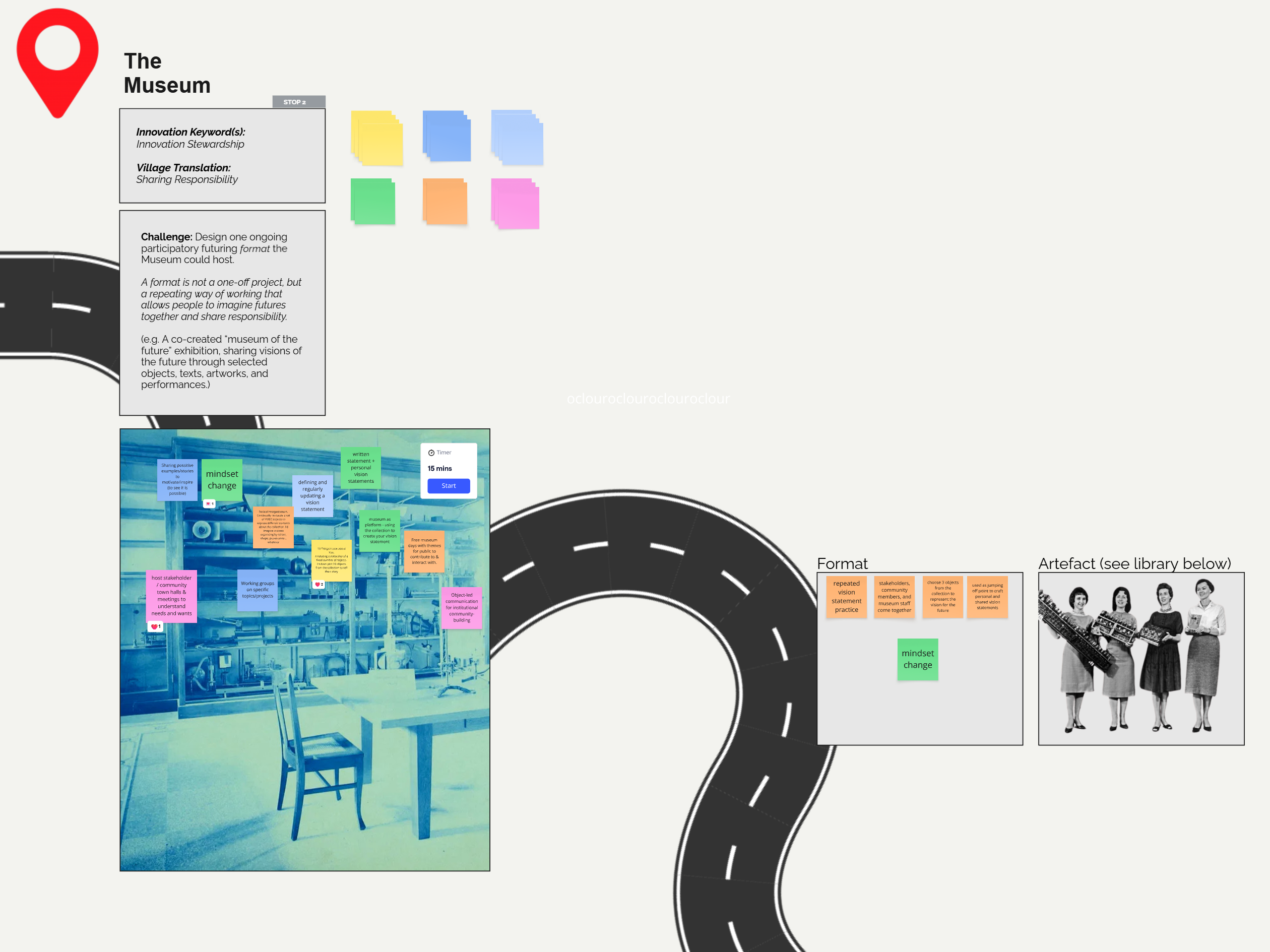
The Museum sits at the centre of the village. It is trusted, visible, and well-resourced. Over time, it has become a place where futures are talked about, but often for the villagers and not with them. As innovation agendas grow more complex, the museum is being asked to hold uncertainty, mediate between different languages, and create space for shared imagination without fixing outcomes too early.
Challenge (script)
Design one ongoing participatory futuring format the Museum could host.
(A format is not a one-off project, but a repeating way of working that allows people to imagine futures together and share responsibility.)
Example (script, optional)
A co-created “museum of the future” exhibition, sharing visions of the future through selected objects, texts, artworks, and performances
Stop 3 – The “ongoing” festival
Innovation Keyword(s): Sustainable Continuity
Village Translation: Making meaningful things that last
Background (script)
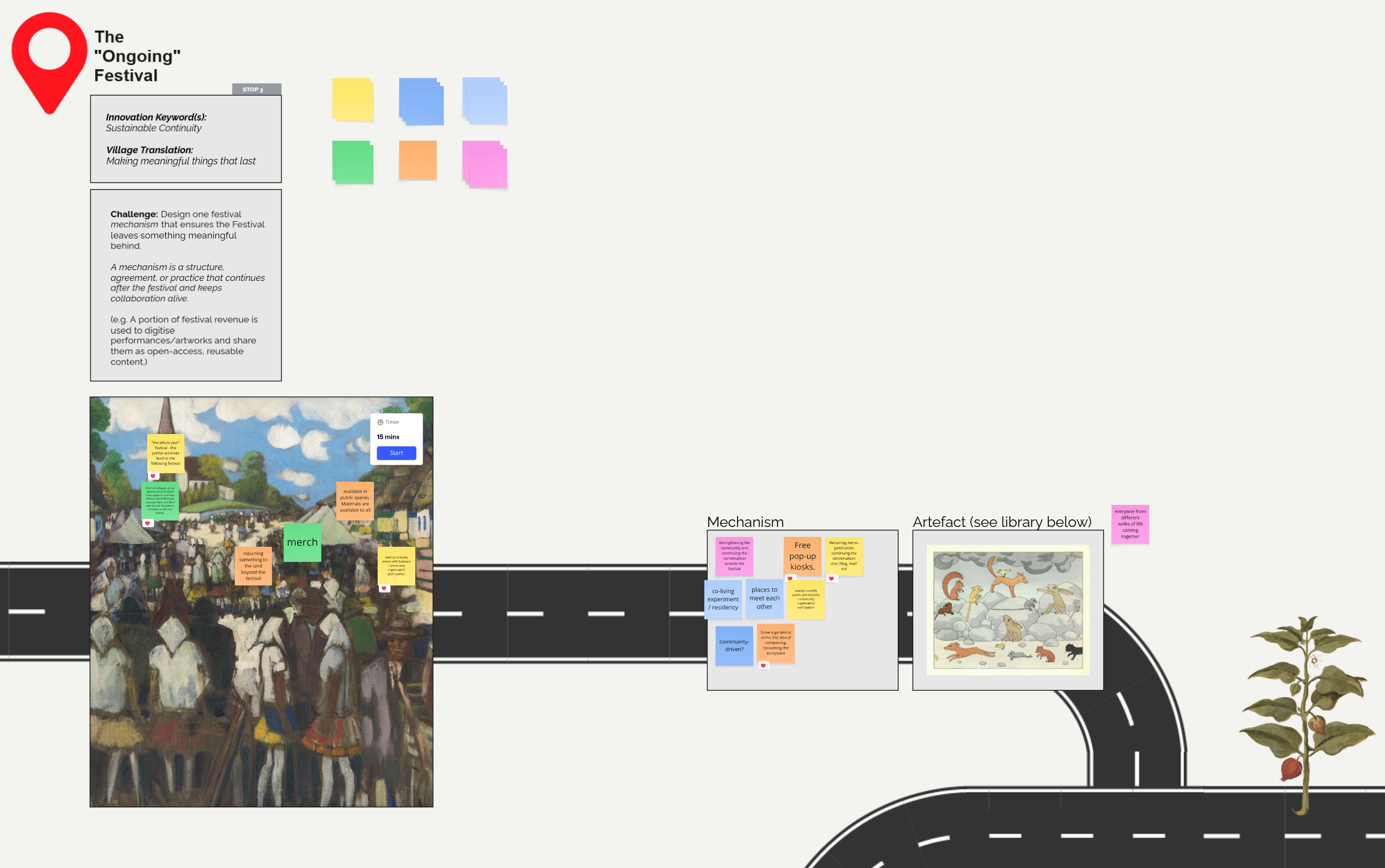
The Festival brings together artists, students, various institutions, and residents in moments of celebration and experimentation. Yet, once the stages come down, the energy disappears. How can the festival become an ongoing part of everyday life in the village, rather than a series of fleeting events?
Challenge (script)
Design one festival mechanism that ensures the Festival leaves something meaningful behind.
(A mechanism is a structure, agreement, or practice that continues after the festival and keeps collaboration alive.)
Example (script, optional)
A portion of festival revenue is used to digitise performances/artworks and share them as open-access, reusable content.
THE TOWN SQUARE
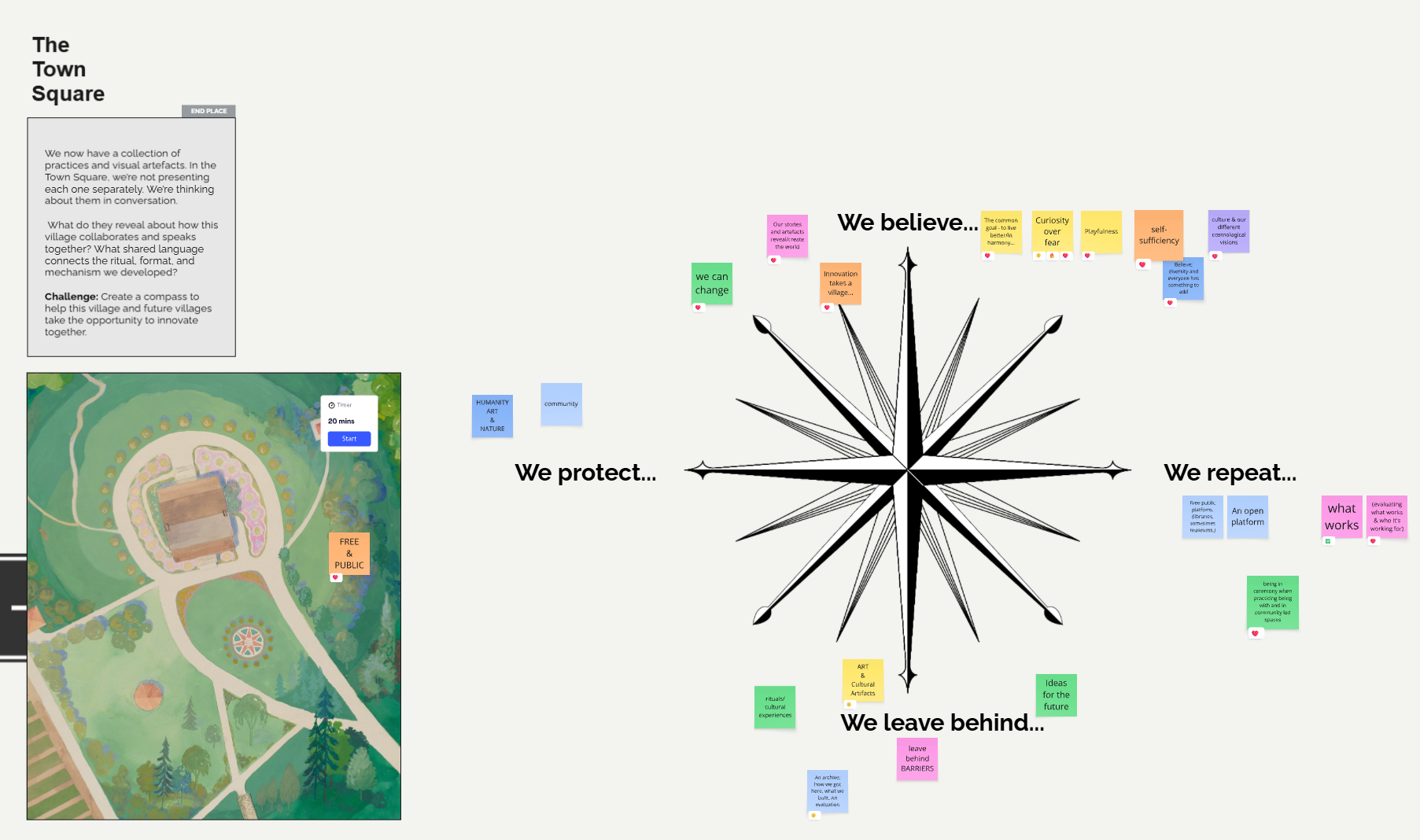
The final stop on the village journey is The Town Square, this is where participants will reflect on what they have created, uncover patterns in their approaches, and consider how these ideas might guide collaboration both now and in future contexts.
Background (script)
We now have a collection of practices and visual artefacts. In the Town Square, we will be thinking about them in conversation with each other. I want you to think about what these practices and artefacts reveal about how our village collaborates and speaks together? What shared language connects the ritual, format, and mechanism we developed? How can we share our ideas with others?
Challenge (script)
Create a compass to help this village and future villages take the opportunity to innovate together. Your compass will follow the 4 pillar statements:
We believe…
We protect…
We repeat…
We leave behind…
Participants will spend approximately 20 minutes at this final stop before proceeding to the next step.
Facilitators might choose to bring the grey boxes (the practices and the artefacts) to the Town Square for easy reference. If participants have been working in a breakout room, then someone should be selected to present their group’s compass to the other groups.
04
Sharing & Reflections
Purpose: Reflect on patterns, language, and practices observed during the village journey, and consider what participants will carry into their own work.
This step helps participants step back from their journey and notice recurring patterns, values, and ways of collaborating.
If participants worked in breakout rooms:
Bring everyone back into the main session.
Invite each group to present their compasses.
As time permits, encourage follow-up questions and reflections. This helps participants notice patterns and shared language across villages.
If participants did not work in breakout rooms:
Invite participants to reflect individually on their own practices, ways of working, and language.
Prompts
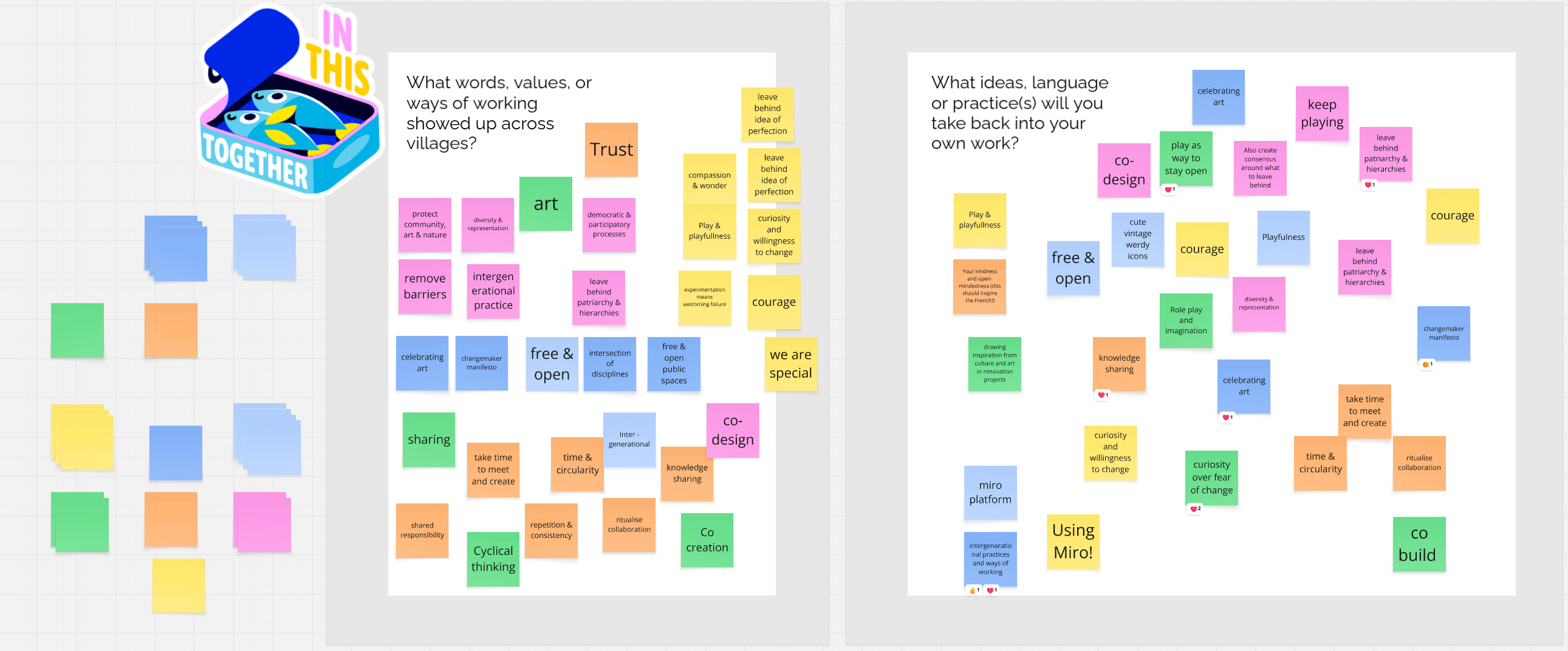
What language or practice will you carry into your own work
(Optional if breakout rooms were used) What words, values, or ways of working showed up across villages?
Conclusion
This workshop helps participants experiment across sectors, uncover shared language, and surface common challenges such as static roles or institutional barriers. Through the hands-on RPG exercises, they test creative solutions, develop practical practices, and explore how collaboration can overcome these challenges. Participants leave ready to apply these insights, fostering more inclusive, adaptable, and impactful ways of working in their own ecosystems.


 AI and Cultural and Creative Industries
 New European Bauhaus – CCIs enabling green transition
 Immersive Media
 Crafts-led Innovation
 Platformisation of the Music Industry
 Inclusivity in Video Game Industry
 Cross-Innovation with Performing Arts
 Fashion Transition: Eco-Design for Circularity
 Cultural Heritage Institutions within Open Innovation Ecosystems
 New funding models for creativity and innovation
 Spaces, infrastructures, and ecosystems for CCIs
 Reimagining Deep-Tech
 Digital Commons