If we want more diverse CCI players to be included in innovation ecosystems that focus on solving local societal challenges, we need to create innovation spaces that are welcoming to them. The following scenarios and blueprints help to imagine ways to expand our definitions of innovation infrastructures beyond the usual university labs, incubators, or fablabs.
Cultural and Creative Industries (CCIs) play an essential role in shaping Europe’s social, environmental, and economic transitions. Yet unlike technology or business sectors, CCIs have access to far fewer intermediaries (such as incubators, accelerators, or public innovation agencies) that help ideas grow into sustainable cultural, social, and place-based innovations. This gap limits their ability to contribute fully to local innovation ecosystems.
(Here, innovation is understood broadly. Beyond technological or market-oriented solutions, it includes ideas for new cultural practices, modes of collaboration, organisational approaches, and ways of engaging communities.)
There is a need to reimagine how public innovation infrastructures are designed, governed, and connected to cultural and creative practices. This begins by collectively exploring new roles for existing public institutions, experimenting with alternative collaboration models, and envisioning infrastructures that meet the specific needs of culturally-driven innovation.
Future Forward Hackathons are ekip’s method for translating emerging societal, technological, and environmental priorities into forward-looking opportunities for the CCIs. Developed as part of this ongoing programme, the following scenarios and blueprints invite participants to imagine how existing public infrastructures could play the role of intermediaries for CCIs.
what is a scenario?
A scenario is a short, structured description of a plausible future situation that helps explore how CCIs might operate, collaborate, or innovate under specific conditions -and within local contexts.
In each scenario we have prepared, there are four key parts;
Local context – the demographic, geographic, institutional, and policy environment.
Local ambitions – the aspirations, pressures, and priorities shaping the future direction of the place.
CCI characteristics – the current profile, practices, and dynamics of creative and cultural professionals in the area.
CCI challenges & needs – the gaps, tensions, or opportunities that public innovation infrastructures could help address.
Together, these elements help participants anchor their imagination in realistic conditions while exploring alternative possibilities.
what is a blueprint?
A blueprint describes the underlying structure needed to sustain a public innovation infrastructure, including the shared foundation, the resources needed, the structure of collaboration, and the governance models that it would need to flourish.
Each blueprint shared includes the following components;
Foundation – the shared values, conditions, or relationships that enable the infrastructure to exist.
Framework – the organising logics or working principles that guide its activities.
Materials – the capacities, skills, or resources required to make it function.
Load-bearing element – the central mechanism or structure that maintains stability and long-term viability.
Design intent – the overarching aim or ethos shaping the infrastructure’s contribution to local innovation.
Scenarios and blueprints help to:
Explore new innovation opportunities for CCIs.
Identify the skills, capabilities, and resources needed to sustain innovation and public infrastructure.
Sketch the contours of future public innovation systems: who provides them, how they function, and what services they offer.
How to use the scenarios and blueprints
Scenarios can act as templates to guide participants through the development of fictional but grounded narratives about new innovation infrastructures that could support the needs of local ecosystems. Although the scenarios describe imaginary futures, they are rooted in urgent challenges faced by cities and regions across Europe. Insights from ekip research, including desk research, social media listening, and interviews, informed the issues they explore.
The scenarios are intentionally written without a single point of view. Whether you are a creative professional, a municipal officer, an educator, a cultural producer, or a community member, you can ‘step into’ the scenario from your own perspective. The aim is to explore how different actors might interpret the same future and what kinds of public innovation infrastructures could support their needs.
Scenarios are not predictions. Rather, they are a prompting tool for imagining alternative futures, identifying opportunities, and grounding speculative infrastructures in realistic and locally relevant contexts. You can use them to:
Explore “what if?” questions about your city, region, organisation, or community.
Surface assumptions and uncertainties, including emerging needs, risks, or new opportunities.
Stimulate creative thinking in meetings, workshops, or strategic planning sessions.
For three of the scenarios (presented below), we have included accompanying blueprints developed during a facilitated co-creation session. Each concept, envisioned within a context of a specific local scenario, presents the potentials of CCI-centered innovation infrastructures and considerations for their sustainability. Use them to:
Give users a simple way to move from imagination to structured thinking.
Map what would be required to make an idea functional and sustainable.
Start conversations with collaborators using a shared, visual reference.
Compare different ideas and assess their feasibility or relevance.
SCENARIO 1:How can geographic peripheries create opportunities, build skills and support innovation capacities of CCIs?
Local context: •Small regional city in central Europe •Population – 90k •No university to carry an innovation agenda forward •Municipality making significant investments towards environmental sustainability •Local art schools produce a number of future professionals in design, music & performing arts
Local ambitions: •Retain creative talent •Become an example of sustainability-driven innovation for other peripheral cities •Get industrial organisations more invested in local issues •Local public organisations – library, museums, arts schools, regional broadcaster – are keen to play a bigger role in innovation activities
CCI characteristics: •Creative and cultural professionals get a strong educational foundation in school, but have little skill-building opportunities after graduation •After graduating, young creatives & cultural professionals move to bigger cities to seek opportunities CCI companies that choose to stay are not actively engaged in innovation activities and rarely collaborate with other sectors
CCI challenges & needs: •Need access to a local audiences open to engage with more experimental products •Need access to a community of peers and collaborators who share similar values •Lack of entry points to start engaging in innovation activities
Blueprint 1: The Neighbourhood House
What if our public innovation infrastructure is a neighbourhood house that facilitates encounters between CCIs, citizens and local business, inviting them to address shared local challenges while practising empathy, shared values and storytelling as key open innovation skills?
Structural Notes
Design Intent: Innovation grounded in a renewed social contract
Foundation: Common ground and intergenerational encounters.
Framework: Experimentation toward shared goals and public values.
Materials: Reciprocity and approachable innovation.
Load-bearing Element: Neighbourhood council for collective governance.
SCENARIO 2: How can a local regeneration strategy create innovation and skill building opportunities for CCIs?
Local context: •A city in Benelux •Historically famous for its mining industry •Regional capital with a population of 120k •Three larger cities in the country have more established and broadly recognised creative industries, each with its own specialisation, namely media, architecture and fashion •The library and concert hall have been reopened recently as a combined venue, following a 30 million Euro investment.
Local ambitions: •To market itself as an upcoming hub for creativity, with more room for experimentation compared to the more established ecosystems in the three larger cities. •Highlight its industrial heritage to also position itself as a year-round tourist destination.
CCI characteristics: •Artists and other creatives work independently, lacking professional networks or collaborative opportunities •The university of applied sciences has recently transformed its communication studies offering to incorporate more digital design courses, including a motion capture studio. As a result, there is a growing digital arts and media scene, but it lacks visibility and integration with the wider community.
CCI challenges & needs: •Creatives struggle to develop innovation projects that would attract funding •Need opportunities to get noticed and showcase their ideas to other sectors and potential funders •Need opportunities for networking, skill-sharing, and mentorship between emerging and established professionals •Lack of examples of CCI support local innovation
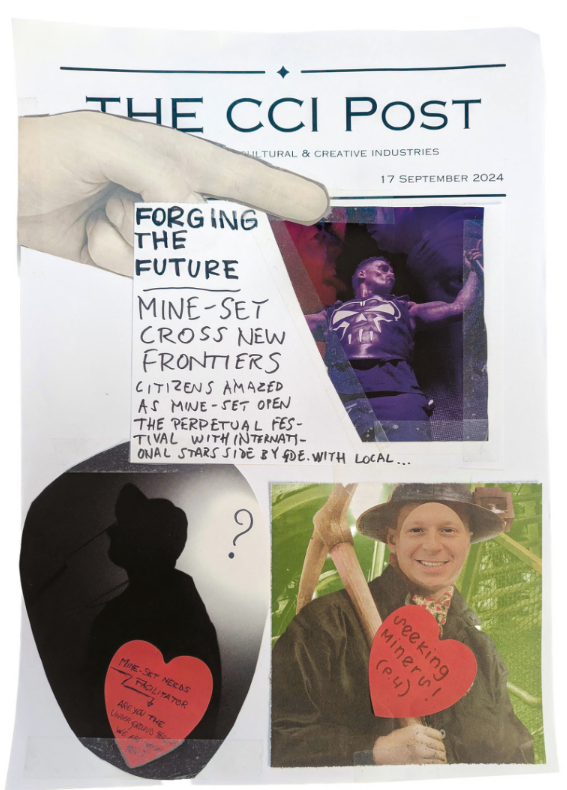
Blueprint 2: The Never-ending City Festival
What if our public innovation infrastructure is an ongoing, interdisciplinary arts festival designed to revitalise the city by connecting its rich industrial heritage and local storytelling to student-led work and community-driven innovation?
Structural Notes
Design Intent: A city as a continuous festival of collaboration and renewal.
Foundation: Innovation feeding local regeneration.
Framework: Affordable housing and cultural vitality intertwined.
Materials: Local stories and community-driven projects.
Load-bearing Element: Community buy-in anchoring the innovation agenda.
SCENARIO 3: How to co-create innovation infrastructures with diverse communities within cities and regions?
Local context: •Regional capital (200k inhabitants) in a densely populated area. •Well connected to other regions by public transport •Biggest policy topic – integration of a fast growing population of expats and refugees •The traditionally conservative local government prioritises road infrastructure investments over social programmes •The big art museum (the main tourist draw) is operating isolated from universities, schools and other public actors in the city
Local ambitions: •Invest in the cultural integration and entrepreneurship of refugee and expat community •Invest in physical public spaces, also to support safety for vulnerable groups •Building creative networks and connections •Engage local industry in innovation around local challenges
CCI characteristics: •Participatory design approaches and expertise working in bottom-up ways •Technology-driven creativity •International influences •Eagerness to engage in innovation activities that would also contribute to cultural integration
CCI challenges & needs: •Language and cultural barriers •Conservative policy focus •Lack of preexisting relationships with local organisations •Relying on project-based, freelance work that does not provide security
Blueprint 3: The Museum as Connector
What if our public innovation infrastructure is a programme of participatory design and futuring workshops and activities – designed by, through, and in a regional art museum – to connect communities and support equitable participation?
Structural Notes
Design Intent: Reflection and participation as measures of innovation.
Foundation: Futuring with communities.
Framework: Partnerships that traverse innovation and CCIs.
Materials: Non–outcome-specific funding and sustained support.
Load-bearing Element: Shared stewardship between institutions and citizens.
SCENARIO 4: How can different generations of CCIs professionals share and build skills together to foster a culture of life-long skill development and innovation?
Local context: •Small regional city in eastern Europe •Long history of crafts and creative practices •Ageing population in need of solutions that would ensure cultural participation and wellbeing •Traditional crafts losing relevance among youth
Local ambitions: •Municipality looking for a way to rebrand itself and attract new investments •Promoting the unique regional identity through craft and design innovation while exploring opportunities offered by digital technologies •Establishing an intergenerational learning community that contributes to the local economy
CCI characteristics:‘Traditional’ or ‘analogue’ creative practitioners and craft makers that are starting to retire. With them, knowledge and skills might be lostYoung creative professionals highly competent in digital skills, digital literacy, online communication
CCI challenges & needs: •Digital divide and clashing values between different generations of CCI professionals •Lack of entrepreneurial skills among CCI professionals •Male-dominated job market •Lack of flexibility in the job market limits the engagement of those with caregiving responsibilities or disabilities
Co-creating with the scenarios
The scenarios and blueprints are best when used together. A simple facilitation sequence might be:
Select a scenario (or co-create one using the template).
Discuss what this future would mean for local needs, institutions, communities, and capacities.
Use the blueprint template to sketch what kind of infrastructure could support this future.
Compare variations, identify tensions, and refine the elements collectively.
We recommend incorporating creative and visual methods into your activities.
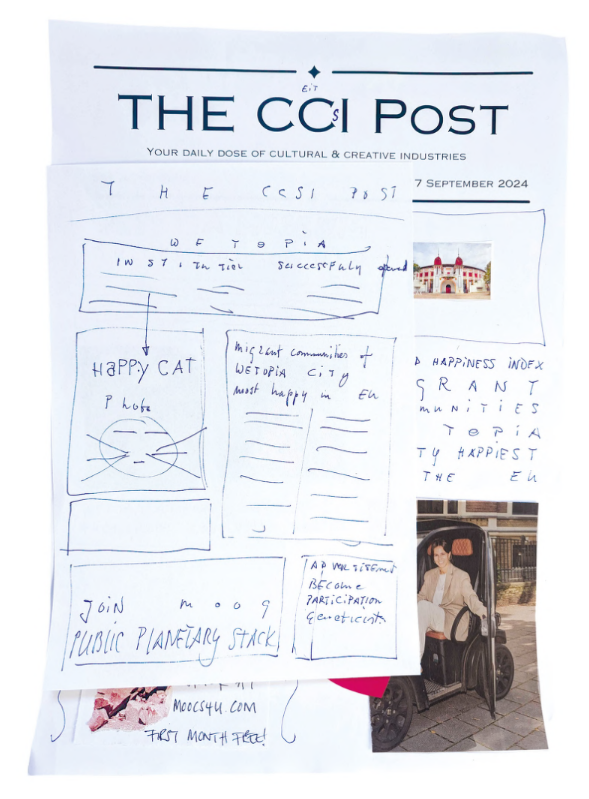
The method we used to generate the blueprints (pictured above) involved creating lonely hearts ads or advice columns, to let participants personify their future initiatives. (To learn more about this format in a workshop setting, you can read our blog recap.)
Another method that could be used involves zine-making which offers a low-barrier, high-creativity way to explore ideas visually. It encourages experimentation and collective storytelling which is especially useful when envisioning unfamiliar futures.
Keep in mind that none of the scenarios or blueprints are meant to be universal. Their value comes from adaptation:
Translate them into your region’s realities, policies, community dynamics, and cultural ecosystem.
Use them to highlight what is missing, what is possible, and what kinds of innovation infrastructure might be most relevant locally.
The following template can support you with this:
Local context:Think about location, population size, educational institutions, and municipal agendas.
Local ambitions:Think about the broader policy context and ambitions of your place. What role is envisioned for CCIs and how do they connect to other sectors?
CCI characteristics:Think about the general profile of creative and cultural professionals, such as what job opportunities they are looking for; and the level of innovation activities among CCI companies.
CCI challenges & needs:Think about what challenges CCIs are facing, such as in skills development and job opportunities, and the opportunities for public infrastructure to play a supportive role.


 AI and Cultural and Creative Industries
 New European Bauhaus – CCIs enabling green transition
 Immersive Media
 Crafts-led Innovation
 Platformisation of the Music Industry
 Inclusivity in Video Game Industry
 Cross-Innovation with Performing Arts
 Fashion Transition: Eco-Design for Circularity
 Cultural Heritage Institutions within Open Innovation Ecosystems
 New funding models for creativity and innovation
 Spaces, infrastructures, and ecosystems for CCIs