AI and Cultural and Creative Industries
 New European Bauhaus – CCIs enabling green transition
 Immersive Media
 Crafts-led Innovation
 Platformisation of the Music Industry
 Inclusivity in Video Game Industry
 Cross-Innovation with Performing Arts
 Fashion Transition: Eco-Design for Circularity
 Cultural Heritage Institutions within Open Innovation Ecosystems
Open-Ended Collaborations: Collaborations for Future & InnovatieLabs
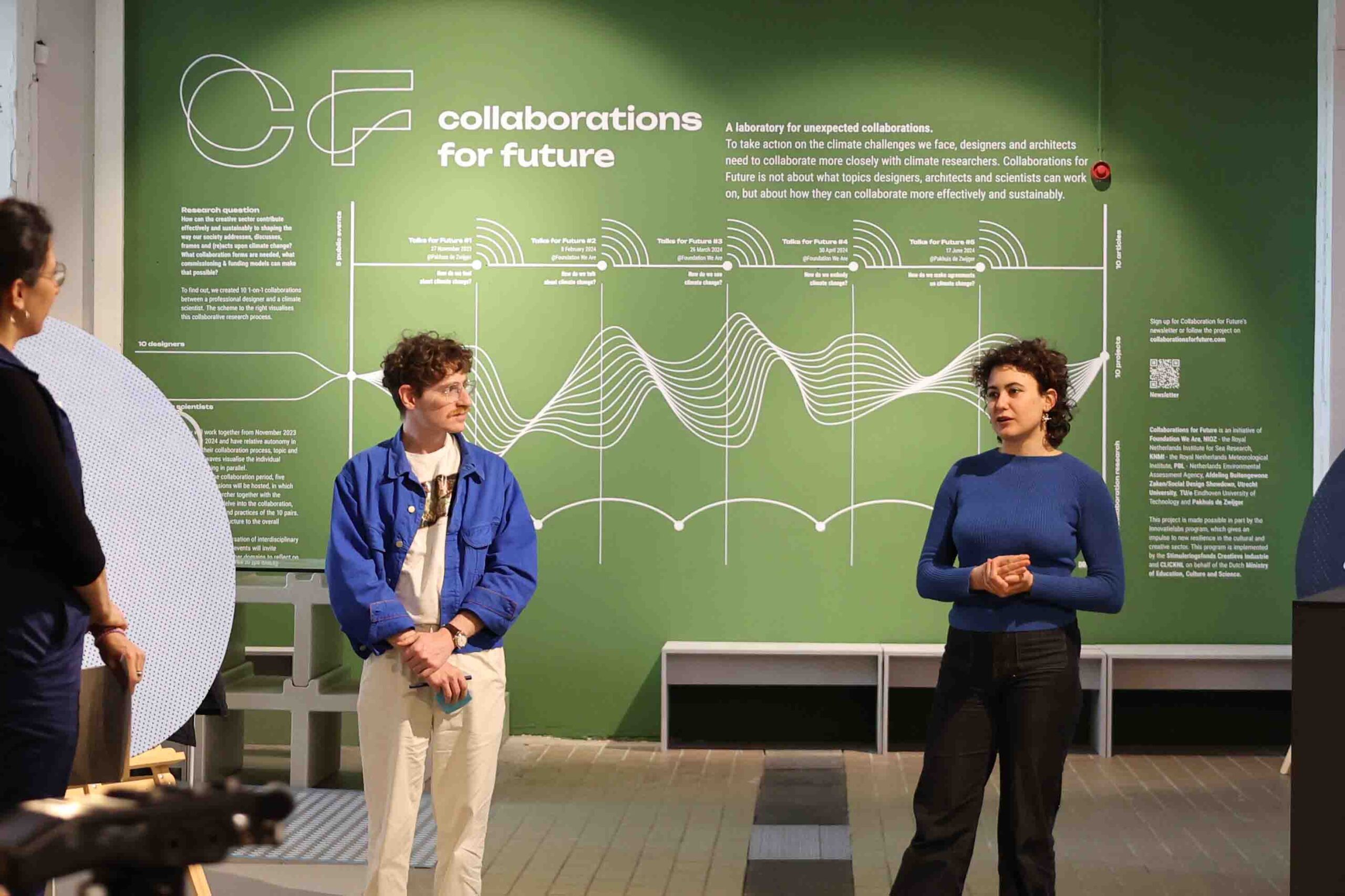
This case study shares insights into how Collaborations for Future (NL) brought together 10 climate scientists and 10 designers to work on tackling the climate crisis, pushing the boundaries of interdisciplinary partnerships. It describes how both the InnovatieLabs funding and the creative process were intentionally open-ended, and how this approach contributes to open innovation ecosystems.
 Source: collaborationsforfuture.com/stories/
-
Author
- Kelly Hazejager, ekip (2025)
-
Geographical scope
-
Region
-
Resource type
Introduction
Collaborations for Future was an interdisciplinary programme (2023–2024) based in the Netherlands and led by Foundation We Are. The programme brought together climate scientists and designers to push the boundaries of interdisciplinary partnerships in response to the climate crisis. Ten designers and ten climate scientists were invited to bring their expertise and methodologies together to explore aspects of the climate crisis through an intentionally open-ended brief. Collaborations for Future was funded by the InnovatieLabs programme (Stimuleringsfonds Creative Industry and CLICKNL) which supports experimental and innovative projects within the cultural and creative industries (CCIs). This funding context enabled Collaborations for Future to prioritise process, experimentation, and collaboration over predefined deliverables or impacts.
Drawing on public project outputs and additional reflections shared by Kornelia Dimitrova, Director of Foundation We Are, this case study offers insights into the opportunities, challenges, and implications of open-ended collaboration for designers, scientists, funders, and policymakers working on complex societal issues such as climate change.
Organisational Context
Collaborations for Future was initiated with the aim of breaking through disciplinary silos and fostering collaboration to address the ‘wicked’ or complex problem of the climate crisis. Their efforts focused on creating space and time for people to truly experiment in collaboration practices without the constraints of pre-defined impacts or outcomes.
This ambition was facilitated by the InnovatieLabs funding programme, which was established in response to the significant impact of the Covid-19 pandemic on the cultural sector, and the search for sustainable ways to recover. It aimed to support innovative approaches to collaboration and support for creative work that pursues societal impact, especially where answers and solutions were not (yet) known.
Challenges and Opportunities
Through their work, Collaborations for Future aimed to address the following challenges:
- Commissioning and funding models that no longer work for design and scientific work, due to their definition of success being tied to pre-defined outcomes.
- The need for more effective climate science communication that encourages people to take agency and responsibility.
- The need for broad, effective and sustainable collaboration between sectors to tackle the climate crisis and inform policy.
With this initiative, they intended to break through silos and demonstrate the value that CCIs can bring to addressing the climate crisis, especially where existing approaches are no longer sufficient. This project was an opportunity to explore the value of the ‘in-between’ spaces, such as between the roles of scientist and designer, in addressing societal issues. The funding provided by InnovatieLabs also proved to be an incubator for open-ended collaborations, giving space to unpack what is truly needed for collaboration and innovation around an important societal issue.
Open Innovation Ecosystems
What does an open-ended process actually look like? Open-endedness was supported structurally in both how the funding from InnovatieLabs was organised, and how Collaborations for Future organised the partnerships between designer and climate scientist.
Initial applications to the InnovatieLabs funding were simple, from which a smaller group was selected and received funding to write a full proposal. This process reflects a more general shift in the field, where it was also supported by matchmaking. Once chosen, projects did not have to deliver an end of project report, but rather quarterly reflections and a final financial report.
This shift to a more open process, also meant more responsibility and more possibilities for the project partners. Managing a project with fixed deliverables and deadlines is familiar, perhaps even easier. In a more open process there are some indicators of the direction you are heading in, but it cannot be managed in the same way. Kornelia emphasises that an important part of the process is to ‘breathe’ with the project, ‘sit on your hands’, and to come to a shared definition of a ‘good’ project. To be fully open to the possibilities, it is important to challenge feelings of scarcity, caused by perhaps limited funds or the need to produce a portfolio or publish a paper. External validation may drive for many the need to build a portfolio or publish papers to secure funding, Collaborations for Future wished to unpick what drives collaborations more generally and what pushes people to work intensely and passionately on a topic.
Measurable Outcomes
One of the key ways in which Collaborations for Future set out to create and measure their own impact, was through different methods of sharing knowledge with a broad range of people. The most tangible outcome are the journeys and projects of the 10 designers working with 10 scientists, which is captured in their publication ‘the Blueprints’.
They also organised five events across the duration of the project to bring together experts from different domains and unpack how their professions approach the work of tackling climate change. In these sessions they explored aspects such as emotion and embodiment, and inspired everyone in the room to think beyond the practices of their own professions. The events were:
- How do we feel about climate change
- How do we talk about climate change
- How do we see climate change
- How do we embody climate change
- How do we make agreements on climate change
To help answer the question of what drives collaborations, the InnovatieLabs programme also facilitated knowledge exchange between the funded projects and university researchers and conducted practice-based research on topics such as business models, the position of the creative maker, and narrative-driven collaboration.
For Kornelia, a clear sign of their impact is the direct feedback she has received from policy makers and funders on how relevant and inspiring Collaborations for Future is as an example to the sector. Their questions often focus on risk, quality, and measurable impact. The publication also features quotes from interviews with funders and policy makers, touching on for example that ‘the way we manage risk is one of our biggest risks.’ By creating a playground for collaboration, and constantly sharing information, insights, and lessons learned, it helps policy makers to know the project intimately.
For more information on Collaborations for Future, see here.