Creative Skills through open innovation speculation: a workshop how-to guide

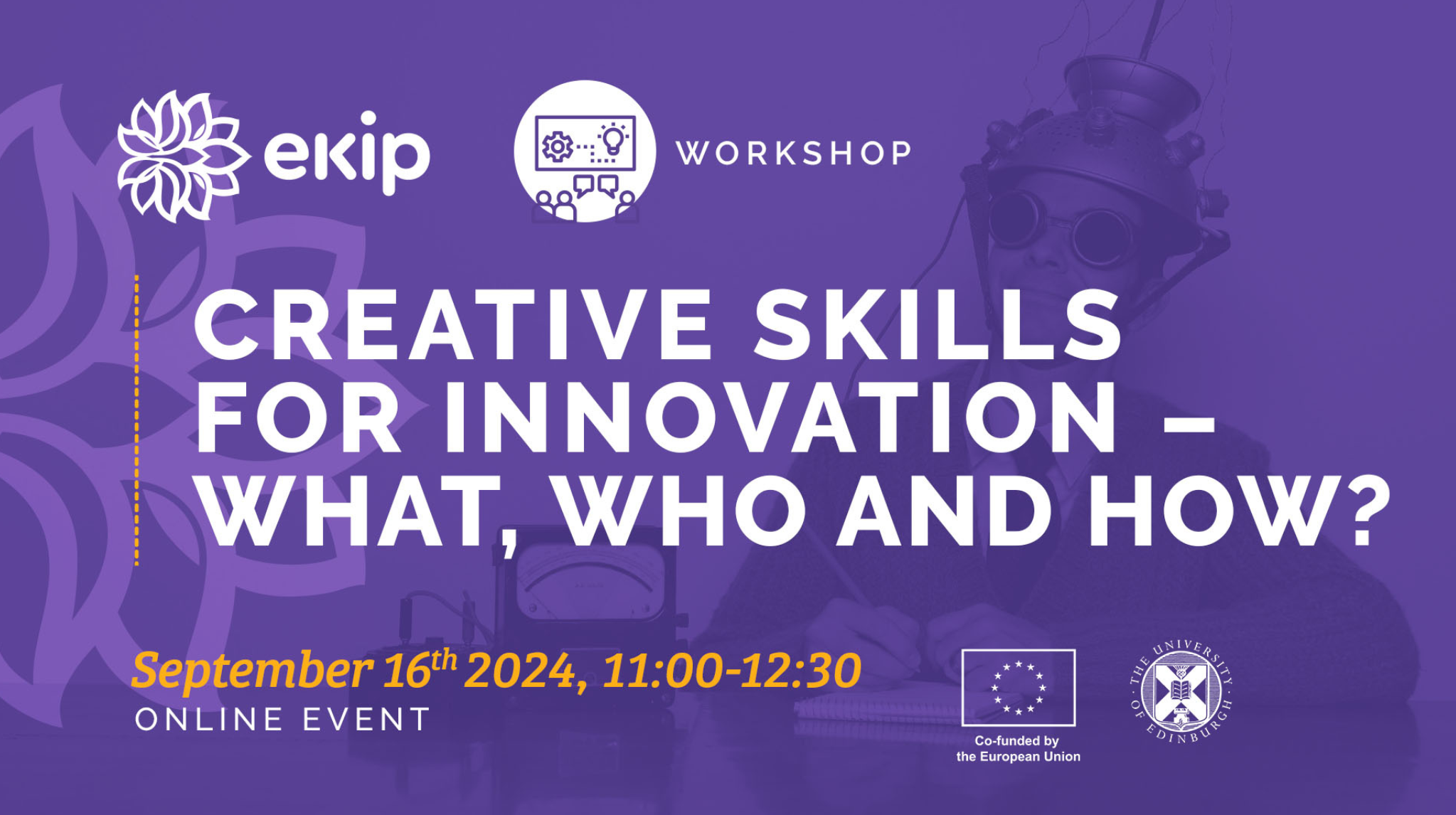
Developed by ekip, this practical resource empowers the CCIs to help people consider how the skills and languages of open innovation relate to practitioners’ everyday practice. This interactive session asks; what skills do creative practitioners bring that could make a positive difference to policymaking, and what could policymakers be doing to make best use of the experiences of the cultural and creative industries?

Creative Skills through open innovation speculation: a workshop how-to guide

Purpose

What do concepts of innovation and innovation policies mean to the creative and cultural industries? And what skills and literacies do creative and cultural organisations and practitioners need to access them? Such questions underpin the EU’s commitments to green transition, digital transition, inclusion, and a better quality of life for Europe’s citizens. However, what that means for the cultural and creative industries (CCIs) and examples of how policies translate into practice are not always visible.

Developed as part of ekip’s ongoing Open Innovation Factories programme, our method for increasing the capacity of the Cultural and Creative Industries (CCIs) to adopt and successfully utilise open innovation principles, we have devised this workshop format to help people consider how the skills and languages of open innovation relate to CCI practitioners’ everyday practice. Participants engage in a series of exercises exploring what skills creative practitioners bring that could make a positive difference to policymaking, and what policymakers could be doing to make best use of the experiences of CCI practitioners.

This guide outlines how to use the assets we created to run your own open innovation speculation workshop.

The Workshop Steps

STEP 1. PRE-WORKSHOP SURVEY
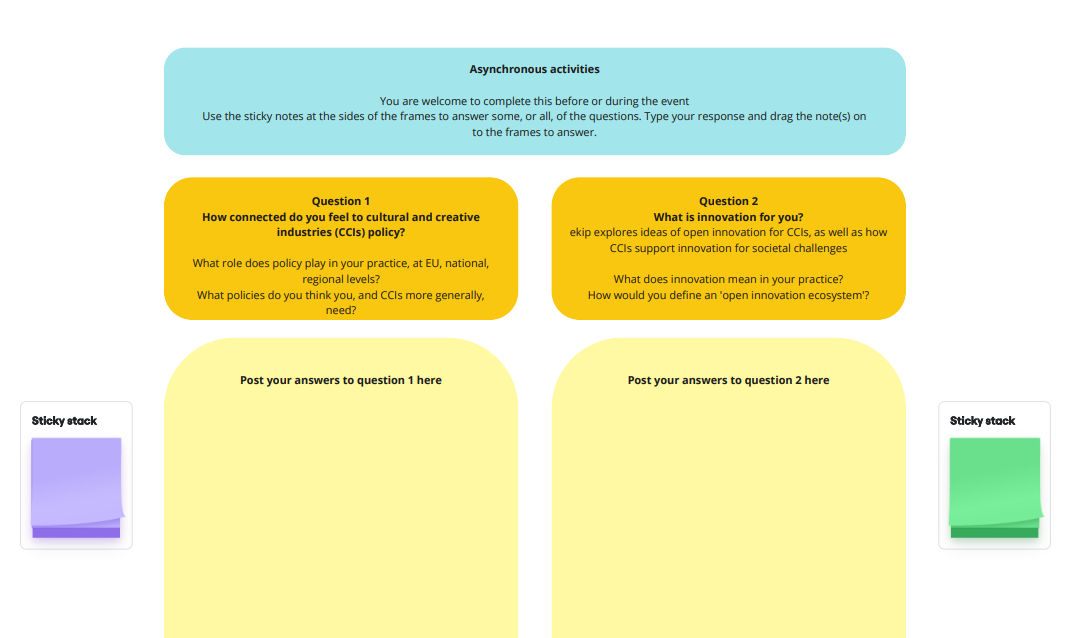
Participants are asked two questions to open a dialogue on the subject of CCI policy and open innovation principles.

STEP 2. DESIGN FICTION: CREATIVE SKILLS FOR INNOVATION
Participants respond to a series of prompts about imagined futures jobs that might become key roles in open innovation ecosystems.

STEP 3. INTERPRETATION: TRANSLATING POLICY INTO PRACTICE
Participants translate the language of existing EU CCI policies into their everyday impacts for creative practitioners.

STEP 4. KEY LEARNING WRAP-UP
A concluding activity asking participants to sum up learning and what they will be carrying forward from the session.

As we take you step-by-step, you will see accompanying visuals and follow-along examples from the first ekip Open Innovation Factory held online during Creative Skills Week 2024. We compiled the activities and prompts for each step into the online whiteboarding tool Miro. A PDF version of our Miro board can be downloaded here for reference:

Note: While we conducted our workshop entirely online, it could be adapted for in-person or hybrid use.


01

PRE-WORKSHOP SURVEY

a. What role does policy play in your practice, at EU, national, and
regional levels?
b. What policies do you think you, and the CCIs more generally, need?

    Question 1 resulted in responses such as the following:

    • Need more policies that propel the role of public organisations (e.g. libraries)
      in innovation ecosystems.
    • EU policy plays a role in validating involvement in innovation activities on new
      topics (e.g. before NEB it was not always easy to prove why involvement in
      sustainability topics was essential for our organisation.)
    • Somewhat – I have the privelege of knowing how to feed into policy, harder to
      know we’re being listened to, and hard to reach the right levels of government
      to make a difference (oddly easier to feed into national than regional policy
      making in my location.)
    02

    design fiction: Creative skills for innovation

    Purpose: through a creative provocation, stimulate novel thinking and gather participants’ imagined futures for how the job market will look for the CCIs in the coming years.

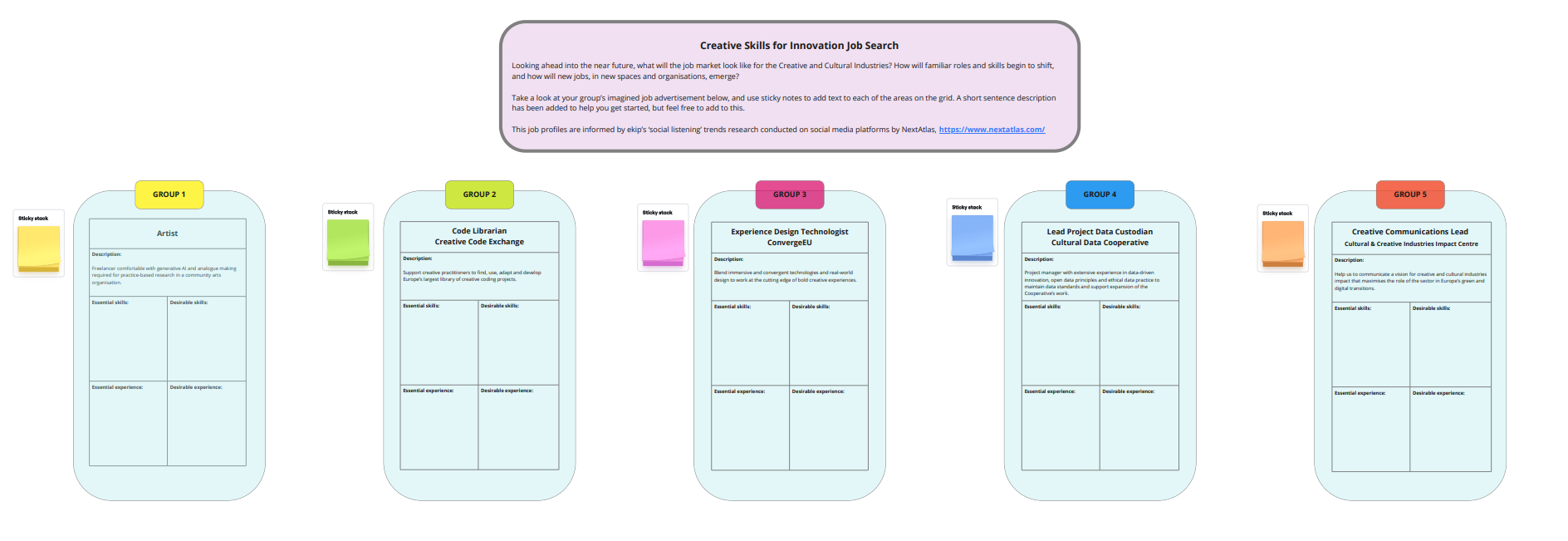
    Drawing on ekip’s prior social listening trends research, we devised five fictional future jobs that might become key roles in future open innovation ecosystems for the CCIs. These included jobs which may exist currently (eg. artist) but which may be greatly transformed through open innovation. The jobs were:

    • Artist: Freelancer comfortable with generative AI and analogue making required for practice-based research in a community arts organisation. 
    • Code librarian, Creative Code Exchange: Support creative practitioners to find, use, adapt and develop Europe’s largest library of creative coding projects.
    • Experience Design Technologist, ConvergeEU: Blend immersive and convergent technologies and real-world design to work at the cutting edge of bold creative experiences.
    • Lead Project Data Custodian, Cultural Data Cooperative: Project manager with extensive experience in data-driven innovation, open data principles and ethical data practice to maintain data standards and support expansion of the Cooperative’s work.
    • Creative Communications Lead, CCI Impact Centre: Help us to communicate a vision for creative and cultural industries impact that maximises the role of the sector in Europe’s green and digital transitions.

    In small groups, participants read a brief job description for each fictional future role and listed the role’s essential skills and experience, and desirable skills and experience.

    Through the process of discussion, participants were able to unpack terms that may be unclear, challenge one another’s thinking about how current trends may evolve, and develop new thinking about how these future roles and skills may begin to happen in the present.

    Taking the Creative Communications Lead role, participants said this imaginary future role’s essential skills would be:

    • Public-facing for both policy-makers and CCIs
    • English language
    • PR skills, writing and digital literacy, eg. press releases and articles
    • Social media and data processing

    Essential experience for this role would be:

    • Communication, ideally business for more structured comms
    • Technical & digital literacy to communicate transitions – knowing vocabulary for this
    • Awareness of green requirements
    • Independence, but able to work in a team

    Desirable skills for this role would be:

    • Social media, content generation
    • Awareness of legal requirements
    • Speaking multiple languages
    • Presentation and pitch skills -efficiently translating across sectors
    • Using new technologies and AI solutions

    Desirable experiences for this role would be:

    • Experience with funding entities on a national and local level
    • Great personal network of partners, media…
    • Acquaintance with CCIs; a creative background
    03

    Interpretation: Translating Policy Into Practice

    Purpose:

    In this exercise, we asked participants to briefly read key points from existing CCI policy documents (documented in the reference sheet below) and to translate how these policies relate to CCI practitioner perspectives. We used the following documents as bases for discussion:

    In Miro, we asked each team to respond to the key policy points and translate them into their own practice and perspectives using the following the prompts:

    • What do cultural and innovation policy mean to CCIs? What skills and
      experiences do you need to translate policy into practice? Also think about
      what is missing – in terms of practitioner perspectives, or cultural and creative
      industries sectors?
    • Think about the jobs we discussed earlier, and the Cultural and Creative
      Industries, more generally. What do these quotes from policy statements
      communicate? What are the skills you need to decipher them and apply them
      to your practice? What do policy and policy recommendations do? Do they
      resonate? Support change? Offer guidance?

    The gap analysis from the 2021-2024 Horizon Europe Strategic Plan discussion
    panel looked like this:

    Source:Policy:
    Horizon Europe Strategic Plan 2025-2027 – Gap Analysis for Cluster 2 – Culture, Creativity and Inclusive Society – Gaps identified in 2021-2024 strategic plan and programmes (p. 130)
    Developments in science, technology, AI, culture, international economic relations, geopolitics and policy, and the post pandemic reality that has emerged have lead to new research gaps, including gaps on:

    Cultural Heritage
    -the European Collaborative Cloud for Cultural Heritage
    -cultural heritage in the context of climate change and sustainability
    -tangible and intangible (including digital and digital-born) heritage in the context of cultural literacy, the role of the arts, the accessibility of culture, European integration and cohesion, and social inclusion
    -silver age tourism and dissonant heritage (referring to visiting places that have been associated with genocide, ethnic cleansing, war or disaster), including the cultural heritage of colonialism

    Digital skills
    -the need for digital skills in the sector 
    -dedicated cultural and creative industry platform, and targeted research on specific cultural and creative industries and on their business models
     
    Various areas (p.105)
    -small cultural organisations
    -the role of volunteering and the role of young people in a new European identity 
    -provenance research

    Taking a look at the above example, participants discussed the gap analysis from the 2021-2024 Horizon Europe Strategic Plan specifying research and innovation gaps to be addressed through future Strategic Plans. By examining these gaps, attendees were able to debate whether they believed progress had been made on the gaps since they were first identified, how these areas relate directly to the activities of CCI practitioners, and whether the EU could benefit from greater global awareness of how other regions are addressing these areas. Participants provided reflections such as the following:

    • What if we had a data-sharing infrastructure for lessons learned and contextual data sharing?
    • “This is not culture” – what do people in communities think the role of EU-level funding interventions is? Often there is disagreement on priorities (eg. integration of minority groups). Understanding gaps between the public and policymakers about the intention of types of cultural intervention is key.
    • Using digital models instead of real heritage venues to protect the venues.
    • Accessibility of the arts – we need to continue to support the most participatory art forms and to strengthen the role of relativity as a skill accessible to everyone (not only professional arts, traditional sectors.)
    • Designers who are successful in industry have informal spaces for learning – too much structure doesn’t give them the skills.
    04

    KEY Learning Wrap-Up

    To conclude the workshop, participants convened to share their key inspirations and
    thought-provoking questions from the experience.

    Some participants expressed a wish to encourage the EU to look beyond its own borders for innovation rather than focusing internally on developing innovation processes. Others focused on the need for being responsive to local needs and desires regarding innovation policy for the CCIs, and tying any wider objectives like green and digital priorities directly to the experiences of audiences and creators. Finally, participants expressed the value of being able to collaborate on a creative thought-provoking process with colleagues in similar positions around the EU to get a sense of what is happening on the ground in
    different locations.

    Conclusions

    By fostering collaboration, imaginative problem-solving, and thoughtful analysis of existing frameworks, this workshop equips participants with tools to better understand and influence open innovation ecosystems. As highlighted throughout, the creative exercises stimulate forward-thinking approaches to CCI policymaking, emphasizing the importance of adaptability, inclusivity, and practical application. By integrating creative insights into policy design and fostering a shared language between practitioners and policymakers, ekip can take a significant step toward more innovative, responsive, and impactful cultural ecosystems.